The Complete History of the United Kingdom: From Ancient Times to Modern Power
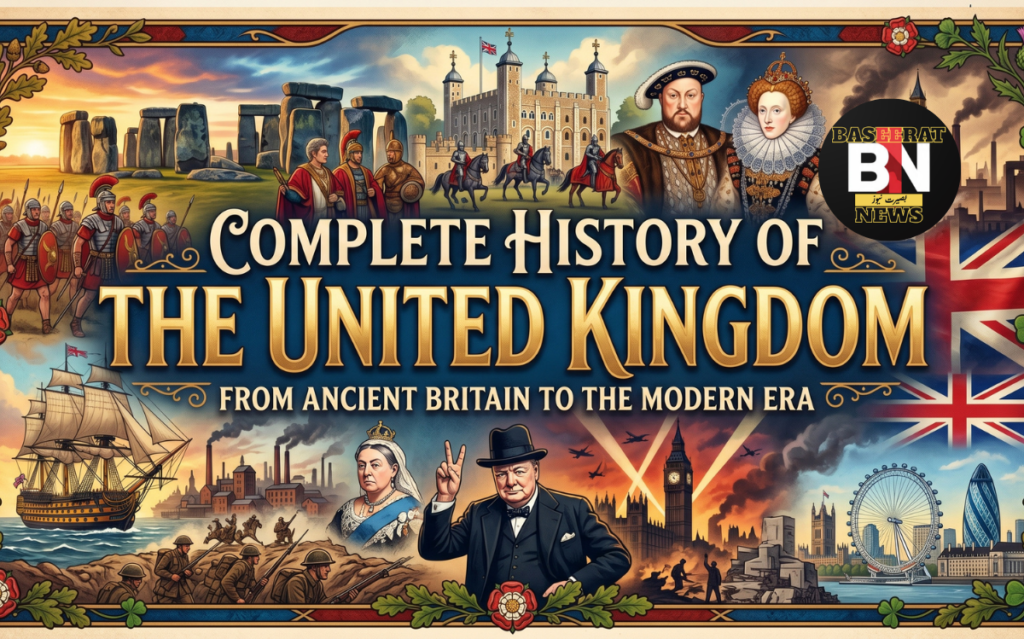
The history of the United Kingdom is a rich and complex story that spans thousands of years, shaped by invasions, cultural transformations, political revolutions, and global expansion. From prehistoric settlements to becoming one of the most influential empires in world history, the UK’s journey reflects resilience, innovation, and adaptation. This comprehensive guide explores the evolution of the United Kingdom in detail, making it ideal for a blog article or educational content.
1. Prehistoric Britain: The Earliest Settlers
Long before written records, Britain was home to early human societies. Archaeological evidence shows that humans inhabited the islands as far back as 800,000 years ago.
One of the most iconic prehistoric monuments is Stonehenge, built around 3000 BCE. Its exact purpose remains debated, though many believe it was used for religious or astronomical purposes.
During the Neolithic and Bronze Ages, farming communities began to develop. These early societies laid the groundwork for future civilizations by introducing agriculture, trade, and structured settlements.
2. Celtic Britain and Tribal Society
Before the Roman invasion, Britain was dominated by Celtic tribes. These tribes were organized into small kingdoms and were known for their warrior culture, artistry, and spiritual beliefs.
The Celts practiced Druidism, a religious system led by priests known as Druids. They believed in nature worship and held ceremonies in sacred groves.
Although the Celts did not have a unified political structure, they played a significant role in shaping early British identity, especially in regions like Scotland, Wales, and Ireland.
3. Roman Britain (43–410 CE)
The Roman Empire, under Emperor Claudius, invaded Britain in 43 CE. The Romans established control over much of England and Wales, introducing advanced infrastructure such as roads, baths, and cities.
One major construction was Hadrian’s Wall, built to protect Roman Britain from northern tribes.
Roman rule brought:
- Urban development
- Improved trade systems
- Introduction of Christianity
However, by 410 CE, the Romans withdrew due to internal issues within the empire, leaving Britain vulnerable to invasions.
4. Anglo-Saxon Period (410–1066)
After the Romans left, Germanic tribes—the Angles, Saxons, and Jutes—invaded Britain. These groups formed several kingdoms, including Wessex, Mercia, and Northumbria.
The Anglo-Saxons:
- Established the English language roots
- Spread Christianity further
- Developed early forms of law and governance
One important historical figure is Alfred the Great, who defended England against Viking invasions and promoted education and legal reform.
5. Viking Invasions and Influence
From the late 8th century, Vikings from Scandinavia began raiding and settling in Britain. They established the Danelaw, a region under Viking control.
The Vikings influenced:
- Language (many English words have Norse origins)
- Trade routes
- Military tactics
Despite their initial brutality, they eventually integrated into British society.
6. The Norman Conquest (1066)
One of the most pivotal events in British history is the Norman Conquest.
In 1066, William the Conqueror defeated King Harold II at the Battle of Hastings. This marked the beginning of the Norman rule in England.
The Normans introduced:
- Feudal system
- Castles (e.g., Tower of London)
- French influence on the English language
The Domesday Book, compiled in 1086, was one of the first detailed records of land ownership.
7. Medieval England and the Magna Carta
During the Middle Ages, England saw the development of centralized monarchy and legal systems.
A major milestone was the signing of the Magna Carta by King John. It limited royal power and laid the foundation for modern democracy.
This period also saw:
- Growth of Parliament
- Expansion of towns and trade
- Religious influence of the Catholic Church
8. The Hundred Years’ War and the Black Death
The Hundred Years’ War (1337–1453) between England and France shaped national identity.
Meanwhile, the Black Death devastated the population, killing nearly one-third of England’s people.
These events led to:
- Labor shortages
- Social unrest
- Economic transformation
9. The Tudor Era (1485–1603)
The Tudor dynasty brought stability after years of civil war.
One of the most famous monarchs was Henry VIII, who broke away from the Catholic Church and established the Church of England.
His daughter, Elizabeth I, ruled during a golden age marked by:
- Exploration (e.g., Sir Francis Drake)
- Cultural growth (e.g., William Shakespeare)
- Defeat of the Spanish Armada in 1588
10. The Stuart Period and Civil War
The 17th century was a time of conflict between the monarchy and Parliament.
The English Civil War resulted in the execution of King Charles I and the temporary abolition of the monarchy.
Oliver Cromwell ruled as Lord Protector before the monarchy was restored.
11. The Glorious Revolution and Constitutional Monarchy
The Glorious Revolution established parliamentary supremacy.
King James II was replaced by William and Mary, who accepted the Bill of Rights, ensuring:
- Limited monarchy
- Parliamentary authority
- Civil liberties
12. Formation of the United Kingdom
The modern UK began forming through political unions:
- 1707: England and Scotland united to form Great Britain
- 1801: Ireland joined, creating the United Kingdom
Later, most of Ireland became independent in 1922, leaving Northern Ireland as part of the UK.
13. The Industrial Revolution
The Industrial Revolution began in Britain and changed the world.
Key developments included:
- Steam engine (James Watt)
- Factories and mass production
- Urbanization
This period made Britain the “workshop of the world.”
14. The British Empire
At its peak, the British Empire was the largest in history, covering about a quarter of the world.
It included regions in:
- India
- Africa
- North America
- Australia
The empire spread:
- English language
- Legal systems
- Trade networks
However, it also involved exploitation and colonial conflicts.
15. World Wars I and II
Britain played a major role in both world wars.
World War I resulted in massive casualties and economic strain.
World War II saw Britain resist Nazi Germany under Winston Churchill.
After WWII:
- Britain’s global power declined
- Colonies began gaining independence
16. Modern United Kingdom
Today, the UK is a constitutional monarchy with a parliamentary democracy.
The current monarch is King Charles III.
Key features of modern UK:
- Strong economy
- Cultural influence (music, film, literature)
- Global diplomacy
The UK has also faced challenges such as Brexit, economic shifts, and debates over Scottish independence.
17. Culture, Society, and Legacy
The UK has had an enormous cultural impact globally.
It has contributed to:
- Literature (Shakespeare, Dickens)
- Science (Newton, Darwin)
- Politics (parliamentary democracy)
British culture continues to influence fashion, media, and global trends.
Conclusion
The history of the United Kingdom is a fascinating journey through time, marked by transformation, conflict, and achievement. From ancient tribes to a global empire and modern democracy, the UK has shaped and been shaped by the world.
Understanding its history provides insight into its current role on the global stage and its continued influence in politics, culture, and economics.