🇮🇳 History of India: Complete Timeline from Ancient Civilisation to Modern Global Power (2026)
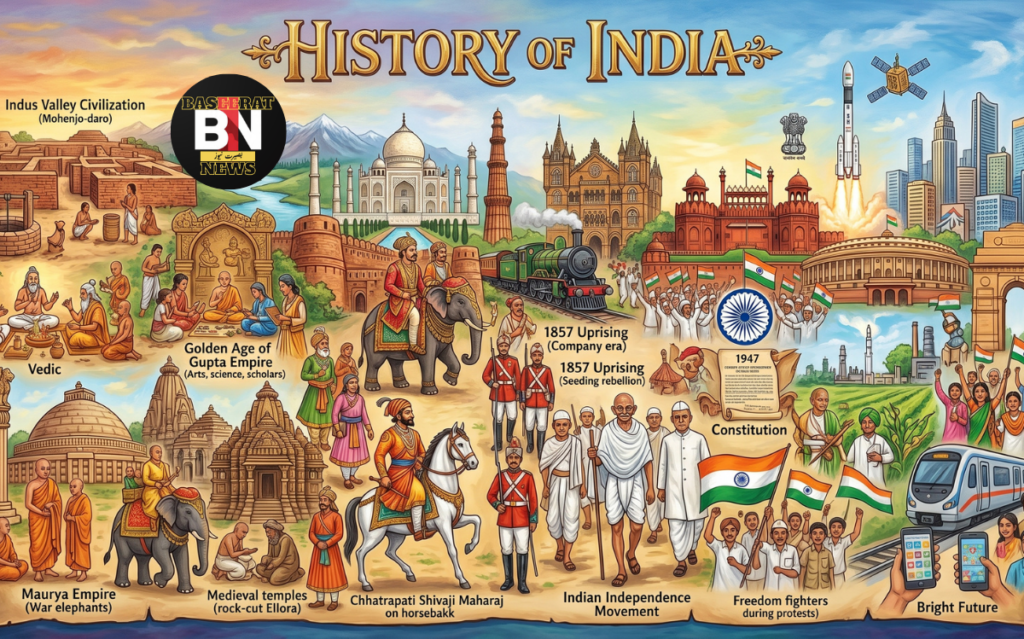
The history of India is one of the oldest, richest, and most complex historical narratives in the world. Stretching from prehistoric settlements to one of the world’s largest modern democracies, India’s past has shaped global civilisation in areas such as science, mathematics, religion, politics, trade, and culture.
Modern historical research—including archaeology, genetics, and economic history—has significantly improved our understanding of India’s past. Recent studies (2023–2026) highlight India’s deep civilizational continuity, diversity, and global influence.
This article provides a **complete, research-based breakdown of India’s history**, covering all major eras with data, examples, and real-world significance.
1. Prehistoric India (Before 2600 BCE)
India’s earliest human presence dates back **hundreds of thousands of years**, confirmed through archaeological and genetic studies.
Key Evidence:
* Stone tools found in the Narmada Valley (early human activity)
* Microlithic cultures across central and southern India
* Early Homo sapiens migration patterns
Recent genomic research shows India’s population is derived from **multiple ancient ancestral groups**, including South Asian hunter-gatherers and later migrations from Central Asia and West Eurasia. ([PMC][1])
Key Features:
* Hunting and gathering societies
* Early stone tool technology
* Gradual development of agriculture
👉 These early populations form the foundation of India’s genetic and cultural diversity today.
2. Indus Valley Civilisation (2600–1900 BCE)
One of the world’s earliest urban civilisations emerged in the Indus Valley.
Major Cities:
* Harappa
* Mohenjo-daro
* Dholavira
According to Britannica, the Indus Civilisation was highly urbanised and technologically advanced.
Key Features:
* Planned cities with drainage systems
* Standardised weights and measures
* Advanced trade networks with Mesopotamia
Economy:
* Agriculture-based (wheat, barley, cotton)
* Trade with Central Asia and the Middle East
👉 The Indus Valley Civilisation represents one of the earliest examples of urban planning in human history.
3. Vedic Period (1500–500 BCE)
After the decline of the Indus Civilisation, Indo-Aryan groups entered the subcontinent.
Key Sources:
* Vedas (Rigveda, Samaveda, etc.)
Social Structure:
* Early caste system beginnings
* Tribal kingdoms (Janapadas)
Major Developments:
* Sanskrit language formation
* Religious evolution toward early Hinduism
* Iron tools and agriculture expansion
👉 This period shaped India’s religious and philosophical foundations.
4. Mahajanapadas and Early Empires (600–321 BCE)
India developed 16 major kingdoms called **Mahajanapadas**.
Important States:
* Magadha
* Kosala
* Avanti
Key Developments:
* Urbanisation increased
* Trade routes expanded
* Rise of early political systems
5. Maurya Empire (321–185 BCE)
The Maurya Empire was India’s first major centralised empire.
Founder:
* Chandragupta Maurya
Peak under Ashoka:
* Controlled most of the Indian subcontinent
Key Achievements:
* Administrative system
* Road networks
* Spread of Buddhism
Ashoka’s reign is considered one of the most influential in Indian history due to his promotion of non-violence and governance reforms.
6. Post-Mauryan Period (185 BCE–300 CE)
After the Mauryas, India saw regional kingdoms:
Key Dynasties:
* Shunga
* Satavahana
* Kushan Empire
Cultural Growth:
* Development of Gandhara art
* Expansion of trade routes (Silk Road)
7. Gupta Empire (320–550 CE) – Golden Age of India
The Gupta period is often called India’s **Golden Age**.
Achievements:
* Advancements in mathematics (concept of zero)
* Astronomy (Aryabhata’s theories)
* Sanskrit literature (Kalidasa)
Recent historical analysis shows this era was marked by **scientific, artistic, and intellectual progress**.
8. Early Medieval India (600–1200 CE)
India became politically fragmented but culturally rich.
Major Kingdoms:
* Cholas (South India)
* Palas (East India)
* Rajputs (North India)
Key Developments:
* Temple architecture
* Maritime trade with Southeast Asia
* Growth of regional languages
9. Delhi Sultanate (1206–1526)
Islamic rule began in northern India with the Delhi Sultanate.
Dynasties:
* Slave Dynasty
* Khilji Dynasty
* Tughlaq Dynasty
Contributions:
* Introduction of Persian culture
* Expansion of trade
* Development of Indo-Islamic architecture
10. Mughal Empire (1526–1857)
The Mughal Empire was one of India’s most powerful and culturally influential periods.
Major Rulers:
* Babur
* Akbar
* Shah Jahan
* Aurangzeb
Achievements:
* Taj Mahal construction
* Strong administrative system
* Cultural fusion of Persian and Indian traditions
Economy:
India became one of the world’s richest economies during this period.
11. European Colonial Period (1600–1947)
Key Powers:
* British East India Company
* British Crown rule (1858 onward)
Impact:
* Economic extraction
* Industrial decline in India
* Introduction of the modern education system
Key Event:
* 1857 Revolt (First War of Independence)
12. Indian Freedom Movement (1857–1947)
India’s independence struggle was one of the largest anti-colonial movements in history.
Key Leaders:
* Mahatma Gandhi
* Jawaharlal Nehru
* Subhas Chandra Bose
Strategies:
* Non-violent resistance
* Civil disobedience
* Mass protests
Outcome:
India gained independence on **15 August 1947**.
13. Partition of India (1947)
India was divided into:
* India
* Pakistan
Consequences:
* Massive migration
* Communal violence
* One of the largest human displacements in history
14. Post-Independence India (1947–1991)
Key Developments:
* Adoption of the Constitution (1950)
* Formation of a democratic republic
* Industrialisation policies
Economic Model:
* Mixed economy
* State-led development
15. Liberalisation Era (1991–2000s)
India opened its economy in 1991.
Effects:
* Foreign investment increased
* IT industry boom
* Rapid urbanisation
👉 India became a global outsourcing hub.
16. Modern India (2000–2026)
India today is:
* 5th–3rd largest global economy (fluctuating rank)
* Largest democracy
* Major tech and innovation hub
Key Sectors:
* IT industry
* Space research (ISRO missions)
* Digital economy
17. India in Global Research and Economy
Recent studies show India is rapidly increasing its global scientific output, though rankings vary depending on methodology.
Key Areas:
* AI and data science
* Space technology
* Pharmaceutical research
18. Cultural and Social Diversity
India is home to:
* 4,000+ ethnic groups
* 1,600+ languages and dialects
Key Features:
* Religious diversity (Hinduism, Islam, Christianity, Sikhism, Buddhism)
* Strong regional identities
19. Political System
India is a:
* Federal Republic
* Parliamentary democracy
Structure:
* President (Head of State)
* Prime Minister (Head of Government)
20. Real-World Global Impact of India
1. Economy:
* Fast-growing global market
2. Technology:
* IT services leader
3. Culture:
* Bollywood influence worldwide
4. Diplomacy:
* Key player in global geopolitics
21. Key Insights Summary
🏛️ Civilisation:
* One of the world’s oldest continuous civilisations
📈 Economy:
* From ancient trade hub to modern tech economy
🌍 Influence:
* Cultural and political impact worldwide
22. Conclusion
The history of India is a story of **continuity, transformation, and global influence**. From the ancient Indus Valley Civilisation to modern technological leadership, India has continuously evolved while maintaining deep cultural roots.
Modern research in archaeology, genetics, and economics continues to uncover new insights, proving that India’s history is not only ancient but also dynamically relevant to the modern world.
👉 India today stands as a bridge between its ancient civilizational heritage and its rapidly advancing global future.