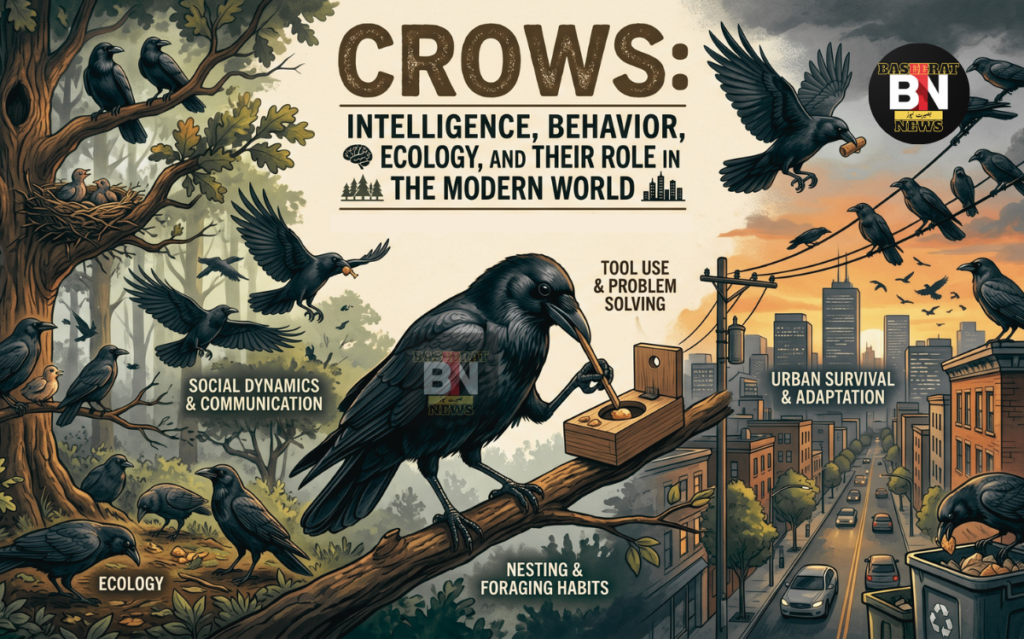
Crows are among the most fascinating and misunderstood birds on Earth. Belonging to the corvid family (which includes ravens, magpies, and jays), crows have gained global attention for their remarkable intelligence, adaptability, and complex social behavior. Recent scientific studies (2024–2025) have pushed our understanding even further, revealing that crows possess cognitive abilities once thought unique to humans and primates.
This article explores all major aspects of crows, including their biology, intelligence, communication, social systems, ecological importance, and real-world applications of crow research.
1. Biological Overview of Crows
Crows belong to the genus Corvus, with over 40 species distributed worldwide. Common examples include:
- Carrion crow (Corvus corone)
- House crow (Corvus splendens)
- American crow (Corvus brachyrhynchos)
Key Characteristics
- Medium to large-sized birds
- Highly adaptable to urban and rural environments
- Omnivorous diet (insects, grains, carrion, human waste)
Their adaptability is one of the main reasons crows thrive in human-dominated environments.
2. Crow Intelligence: Among the Smartest Animals
2.1 Brain Power and Cognitive Abilities
Modern neuroscience has shown that crow intelligence rivals that of primates. Despite having smaller brains, their neuron density is extremely high.
A 2025 study on crows’ brains found that crows exhibit advanced attention control, similar to that of mammals.
Another 2025 study found neural mechanisms for time estimation, showing crows can perceive and judge time intervals—an advanced cognitive skill.
What This Means:
- Crows can focus attention selectively
- They possess working memory
- They can plan and anticipate events
2.2 Problem-Solving and Tool Use
Crows are famous for solving complex problems.
A 2025 experiment showed that hooded crows can understand cooperative tasks involving strings, requiring coordination and reasoning.
Another study revealed that crows can create objects based on mental templates, showing imagination-like abilities.
Real-World Example:
- Crows bend wires into hooks to retrieve food
- They drop nuts on roads for cars to crack
 These behaviors show causal reasoning, not just instinct.
2.3 Numerical and Abstract Thinking
Research indicates that crows can:
- Count (similar to human toddlers)
- Recognize patterns and shapes
- Understand basic geometry (community-reported studies)
Some experiments show crows can vocalize numbers accurately, suggesting symbolic thinking.
3. Social Intelligence and Behavior
3.1 Complex Social Structures
Crows live in structured social groups with:
- Family units
- Cooperative breeding systems
- Alliances and rivalries
A major review highlights that crow intelligence is strongly linked to social complexity.
Key Insight:
The more complex the social environment, the higher the intelligence.
3.2 Communication Systems
Crows use:
- Vocal calls (alarm, food, warning)
- Body language
- Context-specific sounds
Recent research shows bird communication may include proto-language elements, where different calls convey different meanings.
A report notes distinct vocalizations tied to specific contexts, such as feeding or danger.
3.3 Emotional Intelligence
Crows display:
- Mourning behavior (gathering around dead crows)
- Long-term memory of human faces
- Grudge-holding behavior
From community observations:
“They hold grudges… and recognize people.”
4. Learning, Play, and Creativity
4.1 Play Behavior
Play is not just for fun—it supports learning.
A 2025 study found that object play helps crows develop foraging and tool-use skills.
Examples:
- Sliding down snowy roofs
- Playing with sticks or objects
4.2 Innovation and Adaptability
Crows constantly innovate:
- Urban crows use traffic to crack nuts
- Some steal and hide food strategically
Their ability to adapt makes them one of the most successful bird species globally.
5. Interaction with Humans
5.1 Urban Adaptation
Crows thrive in cities due to:
- Food availability (waste)
- Reduced predators
- High intelligence
A study found that crows’ activity is strongly influenced by human presence.
Key Finding:
- When humans disappear → crow activity decreases
This shows they depend on human ecosystems.
5.2 Human Recognition
Crows can:
- Recognize individual human faces
- Remember threats for years
- Communicate danger to other crows
This ability has implications for:
- Wildlife management
- Urban ecology
6. Ecological Importance
6.1 Ecosystem Services
Crows play vital roles in ecosystems:
1. Scavenging
- Clean up dead animals
- Reduce disease spread
2. Seed Dispersal
- Help forests regenerate
3. Pest Control
- Eat insects harmful to crops
A 2025 ecological review emphasizes their role in ecosystem balance and adaptation.
6.2 Environmental Indicators
Crows are indicators of environmental change.
A 2025 study found:
- Noise and artificial light cause stress in crows
- Urban environments alter their behavior
Implication:
Changes in crow behavior can signal ecological problems.
7. Stress, Welfare, and Conservation
7.1 Stress Factors
Modern challenges include:
- Noise pollution
- Light pollution
- Habitat destruction
Studies show these factors:
- Disrupt roosting behavior
- Increase stress levels
7.2 Conservation Efforts
The Hawaiian crow (ʻAlalā) is critically endangered.
Research shows that:
- Housing conditions affect welfare
- Individual personality influences survival
Conservation strategies now consider behavior and temperament.
8. Neuroscience of Crow Intelligence
Crows have:
- Highly developed forebrain (nidopallium)
- Neuron density comparable to primates
Key Discoveries:
- Attention control mechanisms (2025 study)
- Time perception circuits (2025 study)
These findings suggest: Intelligence does not require a mammalian brain structure.
9. Real-World Applications of Crow Research
9.1 Artificial Intelligence (AI)
Crow cognition inspires AI systems:
- Problem-solving strategies
- Efficient learning models
- Adaptability in uncertain environments
9.2 Robotics
Crows’ tool use influences:
- Robotic manipulation systems
- Autonomous problem-solving
9.3 Urban Planning
Understanding crow behavior helps:
- Waste management systems
- Wildlife-friendly cities
9.4 Education and Psychology
Crows are used in research to study:
- Learning behavior
- Decision-making
- Memory systems
10. Cultural and Symbolic Importance
Crows have deep cultural meanings:
In South Asia:
- Associated with ancestors (Hindu rituals)
In Western culture:
- Symbol of mystery or intelligence
In Japan:
- Seen as divine messengers
11. Future Research Directions
Current scientific focus includes:
1. Language Decoding
- Understanding crow communication systems
2. Brain Mapping
- Identifying neural circuits of intelligence
3. Climate Adaptation
- How crows respond to environmental changes
4. Human-Animal Interaction
- Studying co-evolution with humans
12. Key Insights Summary
Intelligence
- Comparable to primates
- Includes planning, counting, and reasoning
Social Behavior
- Complex relationships and communication
Adaptability
- Thrives in cities and changing environments
Ecological Role
- Essential for ecosystem balance
13. Conclusion
Crows are far more than ordinary birds—they are highly intelligent, socially complex, and ecologically essential creatures. Modern research has shown that their cognitive abilities rival those of mammals, challenging traditional views of animal intelligence.
From solving puzzles to recognizing human faces, crows demonstrate that intelligence in nature is diverse and deeply fascinating. Their ability to adapt to urban environments, interact with humans, and maintain ecological balance makes them one of the most important species to study in the modern world.
As science continues to uncover its secrets, one thing is clear:
Crows are not just survivors—they are thinkers, innovators, and key players in Earth’s ecosystems.