The Complete Story of Nokia Phones: Rise, Glory, and the Mobile Revolution
Before touchscreens took over the world, there was a time when mobile phones were simple, strong, and unforgettable. In crowded markets, school classrooms, railway stations, and family living rooms, one sound connected millions of people: the legendary Nokia ringtone.
For an entire generation, Nokia was not just a phone company. It was part of everyday life.
People trusted Nokia phones during emergencies. Teenagers spent hours playing Snake under classroom desks. Travelers carried Nokia chargers like survival tools because the battery could last for days. Some phones survived falls from rooftops, drops into water, and years of rough use. Over time, Nokia became more than technology. It became a memory.
In the late 1990s and early 2000s, Nokia ruled the mobile industry like a giant empire. From the iconic Nokia 3310 to stylish business phones and futuristic camera devices, the Finnish company transformed communication forever. At its peak, nearly half the world’s mobile users carried a Nokia device in their pocket.
But history can change quickly.
The same company that once dominated the world slowly began losing its place as smartphones reshaped the industry. Competitors like Apple and Samsung introduced a new era, while Nokia struggled to keep up with changing technology and consumer behavior.
Yet even today, years after its decline, people still speak about Nokia with emotion and nostalgia. Very few technology brands have left such a deep cultural impact across generations.
This is the complete story of Nokia phones, a journey filled with innovation, success, unforgettable devices, and one of the most dramatic rises and falls in technology history.
Introduction
Long before smartphones became miniature computers, mobile phones had a different purpose. They were designed to connect people in the simplest way possible. During that era, no company understood human needs better than Nokia.
Nokia phones were not luxurious gadgets made only for wealthy users. They were built for everyone. Students, workers, shopkeepers, travelers, business executives, and parents all trusted the same brand. In villages and giant cities alike, Nokia became a symbol of reliability.
What made Nokia special was not only technology. It was the emotional relationship people built with the brand.
A Nokia phone often became someone’s first personal device. For many teenagers in the early 2000s, receiving a Nokia phone felt like a major life moment. People stored family contacts, memorable text messages, and favorite ringtones inside these small devices. The phones became companions during everyday life.
Unlike modern smartphones that constantly demand attention, old Nokia phones were simple and calm. They focused on communication instead of endless notifications. Their physical buttons created a satisfying experience that modern touchscreens can never fully replace.
The company also understood durability better than most competitors. Nokia devices earned a legendary reputation for strength. Internet jokes later claimed that Nokia phones could survive explosions, earthquakes, and impossible accidents. While exaggerated, these jokes reflected real customer experiences. People genuinely trusted Nokia products.
Another reason behind Nokia’s success was battery life. In a time before power banks and fast charging, Nokia phones could operate for days without needing electricity. Travelers and workers appreciated this reliability, especially in areas with limited power access.
The design philosophy of Nokia also stood out. Some phones were compact and professional. Others were colorful and playful. Certain models introduced music features, cameras, internet browsing, and gaming experiences long before smartphones became common. Nokia constantly experimented with creativity.
During its golden years, Nokia represented technological progress itself. The company connected countries, families, and businesses through affordable communication tools. In many developing nations, Nokia phones introduced millions of people to mobile technology for the very first time.
The rise of Nokia was not accidental. Behind the success existed decades of innovation, strategic decisions, and a deep understanding of consumer behavior. The company transformed from a small Finnish business into one of the most powerful technology giants on Earth.
However, the mobile industry changes rapidly. New touchscreen devices entered the market, and user expectations evolved faster than many companies anticipated. Nokia’s once unstoppable dominance slowly weakened under the pressure of modern smartphone competition.
Still, despite losing its throne, Nokia’s legacy remains powerful. Few companies have influenced human communication on such a massive scale. Even younger generations who never owned a classic Nokia phone recognize its cultural importance.
Today, Nokia is remembered not only for its products but also for the emotions attached to them. The memories of typing messages with physical keypads, customizing ringtones, and playing Snake in spare moments continue to live in people’s minds around the world.
The story of Nokia is more than business history. It is the story of an entire technological era that shaped modern digital culture.
Nokia Origins
The history of Nokia began long before mobile phones existed. In fact, the company’s origins can be traced back to the nineteenth century, during a completely different industrial age.
Nokia was founded in Finland in 1865 by an engineer named Fredrik Idestam. Surprisingly, the company did not start with electronics or communication technology. Its first business focused on paper production near the Nokianvirta River, which later inspired the company’s famous name — Nokia.
During its early decades, Nokia operated in several industries. The company produced rubber products, cables, industrial materials, and various electrical goods. At that time, nobody could have imagined that this Finnish business would one day dominate global mobile communication.
Finland itself played an important role in shaping Nokia’s future. The country experienced harsh winters, challenging geography, and a strong need for reliable communication systems. These conditions encouraged technological innovation and practical engineering solutions.
As the twentieth century progressed, Nokia gradually expanded into electronics and telecommunications. The company understood that technology would become increasingly important in the future. Instead of remaining limited to traditional industries, Nokia adapted to changing global markets.
This ability to evolve became one of Nokia’s greatest strengths.
By the 1960s and 1970s, Nokia had entered the telecommunications sector more seriously. The company worked on radio transmission technologies and communication equipment. At the time, global communication systems were still developing, and Nokia saw enormous future potential in mobile connectivity.
One of Nokia’s most important turning points came during the 1980s. The world was beginning to explore cellular networks, and mobile communication technology was advancing rapidly. While many companies hesitated, Nokia invested aggressively in this new industry.
The company focused on creating practical, user-friendly mobile devices instead of overly complicated systems. This strategy later helped Nokia connect with ordinary consumers worldwide.
Early mobile phones were extremely different from modern devices. They were large, heavy, expensive, and mostly used by business professionals. Yet Nokia believed mobile communication would eventually become part of everyday life for ordinary people.
That prediction changed history.
Nokia engineers worked tirelessly to improve portability, battery efficiency, and network quality. Their goal was simple but revolutionary — create mobile phones that anyone could use comfortably.
The company’s innovation culture became famous in the technology world. Nokia encouraged experimentation, engineering creativity, and long-term thinking. Teams constantly searched for ways to improve communication experiences for users.
At the same time, Finland’s education system and engineering talent provided Nokia with highly skilled workers. The company grew rapidly as global demand for telecommunications technology increased.
During the late 1980s and early 1990s, Nokia made one of the most important strategic decisions in its history. It shifted major focus toward telecommunications and mobile devices while reducing involvement in unrelated industries.
This bold move transformed Nokia completely.
Instead of becoming a general industrial company, Nokia positioned itself as a future leader in communication technology. The decision carried significant risks, but it eventually turned the company into a global powerhouse.
The collapse of the Soviet Union during the early 1990s created economic difficulties for Finland, and Nokia faced enormous pressure during that period. Yet rather than collapsing, the company accelerated innovation and expanded internationally.
This difficult era strengthened Nokia’s determination.
By focusing heavily on mobile communication, Nokia prepared itself for the coming digital revolution. The company understood that people wanted freedom, mobility, and instant connection. Mobile phones represented the future of human communication, and Nokia intended to lead that future.
The company’s early vision, combined with smart leadership and relentless innovation, laid the foundation for one of the greatest success stories in technology history.
Rise to Fame
The 1990s became the decade that changed Nokia forever.
As mobile networks expanded across the world, Nokia entered the perfect moment in technological history. Millions of people wanted mobile phones, but the industry still lacked devices that were affordable, reliable, and easy to use. Nokia filled that gap better than anyone else.
While competitors focused heavily on business customers, Nokia understood ordinary people. The company realized that mobile phones would eventually become everyday tools for students, families, workers, and travelers.
This understanding transformed Nokia into a global phenomenon.
One of Nokia’s greatest strengths was simplicity. Its phones featured clean designs, comfortable buttons, clear menus, and user-friendly interfaces. Even people with little technical knowledge could learn how to use Nokia devices within minutes.
At a time when technology often felt complicated, Nokia made communication feel effortless.
Another major advantage was durability. Nokia phones quickly gained a legendary reputation for surviving extreme conditions. Users accidentally dropped them on roads, concrete floors, and staircases, yet the devices often continued working perfectly.
Stories about indestructible Nokia phones spread everywhere. These stories became part of internet culture years later, turning Nokia into a symbol of strength and reliability.
Battery life also played a huge role in the company’s success.
Modern smartphone users often carry chargers throughout the day, but classic Nokia phones could operate for several days on a single charge. In many countries with limited electricity access, this feature made Nokia devices incredibly valuable.
The company also mastered marketing. Nokia advertisements focused on human connection rather than technical specifications. One famous slogan, “Connecting People,” became one of the most recognizable technology slogans in history.
The phrase perfectly captured Nokia’s identity.
Instead of presenting phones as cold electronic devices, Nokia promoted them as emotional tools that strengthened relationships between people. Families stayed connected. Friends communicated easily. Businesses operated more efficiently.
This emotional branding helped Nokia build deep trust among consumers.
By the late 1990s, Nokia had become the world’s largest mobile phone manufacturer. Its devices appeared everywhere — in offices, schools, homes, buses, restaurants, and airports. Owning a Nokia phone became completely normal across many parts of the world.
The company’s rise also reflected broader cultural changes. Society was becoming more mobile, faster, and digitally connected. Nokia stood at the center of this transformation.
Every year, the company introduces new devices designed for different lifestyles. Some phones targeted professionals with advanced business features. Others focused on music, fashion, youth culture, or affordability.
This wide variety allowed Nokia to dominate multiple market segments simultaneously.
In developing countries, Nokia’s influence became especially powerful. Affordable models introduced millions of first-time users to mobile communication. For many families, a Nokia device represented their first connection to the digital world.
The company helped reduce communication barriers across continents.
At its peak, Nokia controlled nearly half of the global mobile phone market. Few technology companies in history have achieved such overwhelming dominance.
The iconic Nokia ringtone became instantly recognizable worldwide. Hearing that sound in public spaces became part of everyday life during the early 2000s.
Meanwhile, Nokia continuously experimented with innovation. The company introduced early camera phones, internet features, gaming devices, and multimedia technology before many competitors recognized their importance.
Models like the Nokia Communicator series gave users access to advanced communication tools years ahead of their time. Other devices focused on style and personalization, especially among younger consumers.
Nokia phones also became cultural symbols.
Teenagers customized covers, wallpapers, and ringtones to express individuality. Business professionals relied on Nokia for reliability during travel. Parents trusted the devices during emergencies because of their dependable battery life.
The company successfully blended technology with human emotion.
However, hidden beneath the success were early signs of future challenges. The technology industry evolves rapidly, and innovation never stops. While Nokia dominated traditional mobile phones, a new era was slowly approaching.
Touchscreens, mobile internet, and smartphone ecosystems were beginning to reshape consumer expectations. Companies like Apple and Samsung would later introduce products that changed the industry completely.
At first, Nokia underestimated the speed of this transformation.
Still, during its golden years, Nokia achieved something extraordinary. It turned mobile phones from luxury business tools into essential parts of daily human life. The company shaped global communication culture in ways that continue to influence technology even today.
The rise of Nokia was not simply about selling phones. It was about changing how humanity connected during the digital age.
Famous Phones
Nokia created hundreds of phone models throughout its history, but a few devices became legendary. These phones were not only successful products. They became cultural icons remembered across generations.
Each model reflected a different moment in technological evolution, and together they tell the story of Nokia’s incredible journey.
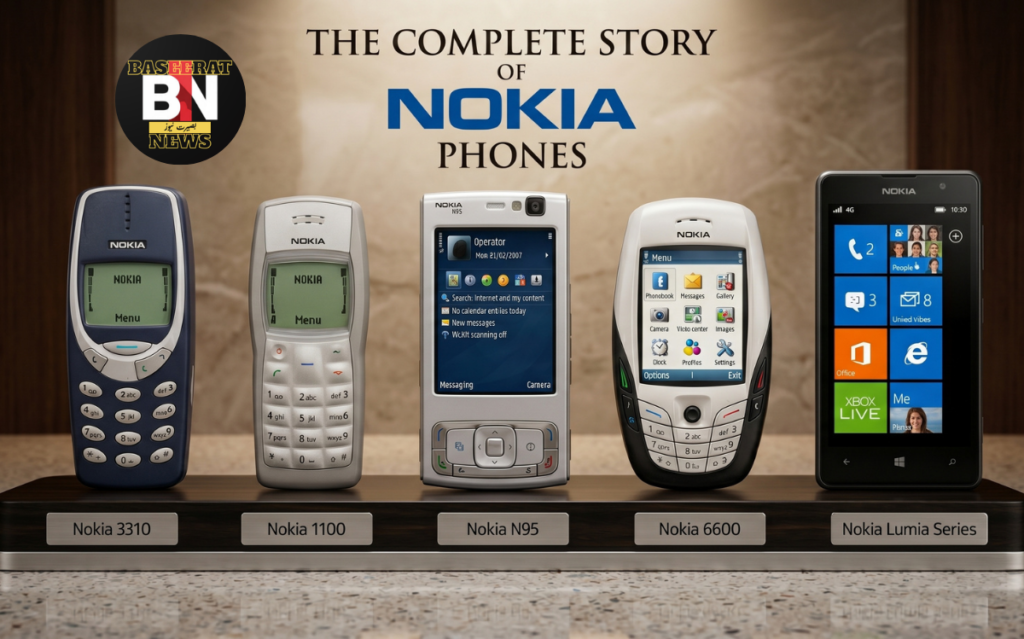
Nokia 3310 — The Indestructible Legend
Few mobile phones in history achieved the level of fame earned by the Nokia 3310.
Released in 2000, the device quickly became one of the most beloved phones ever created. Its simple design, strong battery life, and extraordinary durability made it famous around the world.
The Nokia 3310 was built like a small tank. People dropped it countless times, yet it continued functioning without serious damage. Over time, internet culture transformed the phone into a global meme symbolizing unbeatable strength.
But the device offered more than durability.
It introduced customizable ringtones, replaceable covers, and improved texting features that appealed especially to young users. The phone also included the legendary Snake II game, which became addictive for millions of players worldwide.
The Nokia 3310 sold in massive numbers and became one of the best-selling phones in history.
Even years after smartphones took over, people continued speaking about the device with nostalgia and admiration.
Nokia 1100 — The People’s Phone
While premium smartphones dominate headlines today, the Nokia 1100 quietly became one of the most successful electronic devices ever made.
Released in 2003, the phone focused on simplicity and affordability. It targeted everyday users rather than luxury markets. This strategy proved incredibly successful, especially in developing countries.
The Nokia 1100 featured a flashlight, strong battery performance, and a durable body designed for practical daily use. Farmers, workers, students, and families trusted the device because it was reliable under difficult conditions.
The phone sold over 250 million units globally.
For millions of people, the Nokia 1100 represented their first mobile phone experience. It connected communities, improved communication access, and introduced basic digital technology to new users worldwide.
Nokia N95 — Ahead of Its Time
The Nokia N95 arrived during an exciting technological transition period.
Released in 2007, the phone combined advanced multimedia features with smartphone capabilities long before modern smartphones became dominant. Many technology experts still consider it one of Nokia’s greatest engineering achievements.
The N95 included:
- A powerful camera
- GPS navigation
- Internet browsing
- Music playback
- Video recording
- Expandable storage
At the time, these features felt futuristic.
The sliding design gave the phone a stylish identity, while multimedia functions attracted technology enthusiasts who wanted more than simple communication devices.
In many ways, the Nokia N95 predicted the future of smartphones. Unfortunately for Nokia, competitors later refined these ideas more successfully.
Still, the N95 remains one of the most respected devices in mobile history.
Nokia 6600 — The Youth Icon
During the early 2000s, the Nokia 6600 became especially popular among younger users.
Its rounded design looked modern and different compared to traditional phones. The device supported multimedia messaging, video recording, and downloadable applications, giving users a more interactive mobile experience.
For many teenagers, owning a Nokia 6600 felt fashionable and exciting.
The phone also gained popularity because of the Bluetooth sharing culture. Friends exchanged songs, wallpapers, games, and videos using wireless transfers. This created social experiences around mobile technology long before social media apps existed.
The Nokia 6600 became deeply connected to youth culture during its era.
Nokia Lumia Series — The Smartphone Gamble
As touchscreen smartphones transformed the market, Nokia attempted a dramatic comeback through the Lumia series.
These devices featured colorful designs, impressive cameras, and the Windows Phone operating system developed by Microsoft. Models like the Lumia 920 received praise for photography quality and creative hardware engineering.
The Lumia phones looked fresh and different compared to competitors.
However, despite strong hardware, Nokia struggled because the app ecosystem remained weak compared to the Android and iPhone platforms. Consumers increasingly prioritize applications and software experiences rather than hardware alone.
The Lumia series represented both Nokia’s ambition and its difficult battle for survival in a rapidly changing market.
Although the comeback never fully succeeded, many technology fans still appreciate Lumia devices for their innovation and design courage.
Snake Game
Long before mobile gaming became a billion-dollar industry, a tiny digital snake captured the attention of millions.
The Snake game became one of the most unforgettable parts of Nokia’s history. Simple, addictive, and endlessly entertaining, it transformed boring moments into exciting challenges for an entire generation.
Whether waiting for a bus, sitting in classrooms, or relaxing at home, people everywhere played Snake on their Nokia phones.
The concept was incredibly simple. Players controlled a snake moving across the screen while collecting small objects to grow longer. The challenge increased as the snake expanded, making movement more difficult over time.
Yet despite its simplicity, Snake became almost impossible to stop playing.
Part of the game’s magic came from timing. During the late 1990s and early 2000s, portable gaming devices were still expensive and less accessible. Nokia phones suddenly placed entertainment directly into people’s pockets.
This small feature changed mobile culture forever.
Students secretly played Snake during lectures. Workers played during short breaks. Friends competed for high scores and shared gaming strategies. In many ways, Snake became one of the world’s first truly global mobile gaming experiences.
The game also represented Nokia’s understanding of user behavior.
The company realized that phones were becoming more than communication devices. People wanted entertainment, personalization, and emotional experiences. Snake added fun and personality to Nokia phones, helping users feel more connected to their devices.
Unlike modern mobile games filled with advertisements and complicated systems, Snake remained beautifully simple. There were no online purchases, social media accounts, or distracting notifications.
Just pure gameplay.
The black-and-white graphics may look primitive today, but during its era, Snake felt revolutionary. It proved that mobile phones could deliver entertainment alongside communication.
This idea later inspired the entire mobile gaming industry.
Over time, Snake became deeply connected to Nokia’s identity. Mentioning Nokia immediately reminded many people of the famous game. Even users who forgot phone model numbers still remembered spending hours chasing high scores on tiny screens.
The emotional connection remains powerful even today.
Modern gaming technology has advanced far beyond Snake, but nostalgia continues to keep the classic game alive. Many smartphone users still download modern versions to relive childhood memories.
The legacy of Snake extends beyond entertainment. It demonstrated how simple digital experiences could create a massive cultural impact. Without complex graphics or advanced technology, the game united millions through shared enjoyment.
That achievement perfectly reflected Nokia’s greatest strength, making technology feel human, accessible, and memorable.
Why Nokia Failed
At one point, Nokia looked unstoppable.
The company controlled a massive share of the global mobile phone market and sold millions of devices every year. In many countries, Nokia phones were everywhere. People trusted the brand more than almost any competitor. Industry experts believed Nokia would dominate mobile technology for decades.
But history can change faster than even giant companies expect.
The beginning of Nokia’s downfall arrived quietly. During the mid-2000s, the mobile industry started shifting from simple communication devices toward smarter, internet-focused experiences. Consumers no longer wanted phones only for calls and text messages. They wanted apps, touchscreens, cameras, music, and internet browsing in one device.
Nokia saw these changes, but it reacted too slowly.
One of the company’s biggest problems was overconfidence. After years of dominating the market, Nokia believed its success and brand loyalty would continue automatically. Executives underestimated how quickly consumer behavior could change once smartphones entered the market.
Then came a moment that changed the entire industry forever.
In 2007, Apple Inc. introduced the iPhone. Unlike traditional mobile phones, the iPhone focused heavily on touchscreens, smooth software, internet browsing, and app experiences. It felt modern, elegant, and futuristic.
At first, many companies, including Nokia, did not fully understand the iPhone’s long-term impact.
Nokia still believed physical keyboards and traditional mobile designs would remain dominant. The company continued producing multiple device styles while competitors focused heavily on improving smartphone ecosystems.
Meanwhile, Google launched Android, giving smartphone manufacturers access to a flexible operating system that rapidly expanded worldwide. Companies like Samsung Electronics adapted quickly and aggressively entered the smartphone race.
Nokia struggled to keep pace.
Another major issue was software. While Nokia’s hardware remained impressive, its Symbian operating system started feeling outdated compared to Android and iOS. Menus looked complicated, touch performance felt slower, and app development became difficult.
Consumers increasingly cared about software experience rather than hardware durability alone.
Modern users wanted app stores, social media access, touchscreen convenience, and seamless internet integration. Nokia phones still offered reliability, but reliability was no longer enough to dominate the market.
Internal company problems also played a major role.
Reports later suggested that Nokia suffered from slow decision-making, fear within management structures, and communication problems between leadership teams. In fast-moving technology industries, delayed decisions can become extremely dangerous.
While competitors innovated rapidly, Nokia often moved cautiously.
The company also released too many different models at the same time. Instead of building one strong smartphone ecosystem, Nokia spread resources across numerous devices and strategies. This made it harder to compete against focused rivals like Apple.
Then came one of the most controversial decisions in Nokia’s history.
In 2011, Nokia partnered with Microsoft and adopted the Windows Phone operating system for its Lumia smartphone series. The hardware looked beautiful, and many critics praised Lumia’s camera quality and design.
However, the software ecosystem struggled badly.
Developers focused mainly on Android and iPhone apps, leaving Windows Phone users with limited application choices. Consumers increasingly chose phones based on available apps, and Nokia could not compete effectively in that environment.
The smartphone war became less about phones themselves and more about ecosystems.
Apple built a powerful ecosystem around iOS. Android companies created massive app marketplaces and customization options. Nokia entered the battle too late and with weaker software support.
Sales declined rapidly.
In 2014, Nokia’s mobile phone business was sold to Microsoft, marking the end of an era. For millions of fans around the world, the news felt emotional. A company that once ruled the mobile world had lost its throne.
Yet Nokia’s failure was not caused by a lack of talent or innovation.
In fact, Nokia created many advanced technologies before its competitors. The problem was timing, leadership decisions, and difficulty adapting to changing consumer expectations. The company mastered the keypad era but struggled during the smartphone revolution.
Still, despite its decline, Nokia’s story remains one of the most important lessons in business history.
No company, no matter how powerful, can survive without continuous adaptation. Technology changes quickly, and even industry giants must evolve constantly to stay relevant.
Nokia’s rise inspired the world.
Its fall warned the world.
And its legacy still lives on in the memories of millions who once carried those legendary phones in their pockets.
Nokia Today
Although Nokia no longer dominates the smartphone market, the company still exists and continues operating in the technology world.
Today, Nokia focuses heavily on telecommunications infrastructure, networking technology, and digital communication systems rather than competing directly as a major smartphone giant. The company plays an important role in building global 5G networks and internet infrastructure.
In many ways, Nokia returned to its engineering roots.
Meanwhile, Nokia-branded smartphones and feature phones are produced through partnerships with companies like HMD Global. These modern devices mainly use the Android operating system and target users who appreciate reliability, clean software, and affordable pricing.
Some newer Nokia phones also attempt to revive nostalgia by redesigning classic models like the Nokia 3310.
While these devices cannot recreate Nokia’s former dominance, they successfully remind older generations about the company’s golden era. Many people still purchase Nokia phones because of an emotional connection and trust in the brand name.
Nokia’s modern identity is very different from its peak years, but its influence on mobile history remains enormous.
The company helped introduce billions of people to mobile communication. It shaped global technology culture, pioneered mobile innovation, and created some of the most iconic phones ever made.
Even today, hearing the classic Nokia ringtone instantly brings back memories for millions around the world.
Very few technology companies leave behind such a powerful emotional legacy.
Conclusion
The story of Nokia is far more than the history of a mobile phone company. It is the story of an entire technological generation that changed the way humanity communicates.
For millions of people around the world, Nokia phones were present during important moments of life. They carried first text messages, late-night conversations, family phone calls, business discussions, and unforgettable memories. Long before social media notifications and endless smartphone apps filled daily life, Nokia created a simpler kind of connection — one built around reliability and human interaction.
That emotional connection is the reason Nokia remains unforgettable even today.
During its golden era, Nokia did something extraordinary. The company transformed mobile phones from expensive business tools into everyday necessities. In villages, crowded cities, schools, offices, and homes, Nokia devices became trusted companions. Their batteries lasted for days, their bodies survived rough conditions, and their simple designs made technology accessible for everyone.
Very few brands in history have achieved that level of global trust.
Nokia also represented innovation and ambition. The company introduced advanced cameras, mobile internet features, multimedia experiences, and gaming culture long before smartphones fully dominated the world. Devices like the Nokia 3310, Nokia 1100, and Nokia N95 became more than products. They became symbols of an era.
The legendary Snake game turned spare moments into entertainment. The famous Nokia ringtone became part of daily life. Even the physical keypad sounds still live inside people’s memories decades later.
But the technology world never stands still.
As smartphones changed consumer expectations, Nokia struggled to adapt quickly enough. The company that once led the industry suddenly found itself chasing competitors during the touchscreen revolution. Strategic mistakes, software problems, and slow decision-making allowed rivals like Apple and Samsung to reshape the market.
Nokia’s fall became one of the most powerful lessons in business history.
Success alone is never permanent. Even the world’s strongest companies must continue evolving if they want to survive rapid technological change. Nokia mastered the keypad era beautifully, but the smartphone age demanded a completely different approach.
Yet despite losing its throne, Nokia never disappeared from history.
Today, the company continues working in telecommunications and networking technology while newer Nokia-branded phones keep the name alive for modern audiences. More importantly, the emotional legacy of Nokia remains stronger than ever.
People still smile when they remember their old Nokia phones.
Some remember playing Snake during school breaks. Others remember dropping their Nokia phone countless times without damage. Many remember the excitement of receiving their very first mobile phone and hearing that iconic ringtone for the first time.
These memories transformed Nokia into more than a technology brand.
It became part of human culture.
In many ways, Nokia represents a unique moment in history — the bridge between the old world and the modern digital age. It connected families across distances, introduced millions to mobile communication, and helped shape the foundations of today’s smartphone society.
That is why the Nokia story still matters.
Not only because of the phones themselves, but because of the emotions, memories, and cultural impact they created around the world. Few companies have ever connected people so deeply, both technologically and emotionally.
And perhaps that is Nokia’s greatest achievement of all.
FAQs About Nokia Phones
1. Why were Nokia phones so popular?
Nokia phones became popular because they were durable, easy to use, affordable, and reliable. Their strong battery life and simple interface made them perfect for everyday users around the world.
2. What was Nokia’s most famous phone?
The Nokia 3310 is widely considered the company’s most famous phone because of its incredible durability, long battery life, and cultural popularity.
3. Why did Nokia phones last so long?
Nokia focused heavily on hardware quality and battery optimization. Their phones used simple software systems that consumed less power and created fewer technical problems.
4. What made Nokia phones “indestructible”?
Many Nokia phones used strong plastic bodies and compact internal designs that helped them survive drops and rough usage better than many modern smartphones.
5. What was the Nokia Snake game?
Snake was a simple but highly addictive mobile game where players controlled a growing snake while collecting objects on the screen. It became one of the earliest global mobile gaming sensations.
6. When did Nokia become famous?
Nokia rose to worldwide fame during the 1990s and early 2000s as mobile phones became more common globally.
7. Did Nokia invent the mobile phone?
No, Nokia did not invent the mobile phone, but the company helped popularize mobile communication for ordinary people around the world.
8. Why did Nokia fail?
Nokia failed mainly because it reacted slowly to the smartphone revolution, struggled with outdated software, and underestimated competitors like Apple and Android manufacturers.
9. What happened after Nokia failed?
Nokia sold its mobile phone division to Microsoft in 2014, ending its dominance in the consumer phone market.
10. Is Nokia still making phones today?
Yes, Nokia-branded phones still exist through partnerships with HMD Global, which produces Android smartphones and feature phones.
11. What operating system did Nokia use before Android?
Nokia mainly used the Symbian operating system before later experimenting with Windows Phone software.
12. What was special about the Nokia 1100?
The Nokia 1100 became famous for its affordability, flashlight feature, long battery life, and incredible reliability in difficult conditions.
13. Why do people still love Nokia phones?
Many people feel nostalgic about Nokia phones because they remind them of childhood memories, simpler technology, and dependable communication experiences.
14. Did Nokia ever make smartphones?
Yes, Nokia created several advanced smartphones, including the Nokia N95 and Lumia series, before modern smartphone competition became intense.
15. What was Nokia’s slogan?
Nokia’s famous slogan was “Connecting People,” which reflected the company’s focus on communication and human connection.
16. Which Nokia phone sold the most units?
The Nokia 1100 became one of the best-selling electronic devices in history, selling more than 250 million units worldwide.
17. Why were Nokia batteries so strong?
Older Nokia phones used lightweight operating systems and less power-hungry hardware, allowing batteries to last for days instead of hours.
18. What country is Nokia from?
Nokia originated in Finland and became one of the country’s most globally recognized technology companies.
19. Did Nokia create touchscreen phones?
Yes, Nokia developed touchscreen devices before smartphones became mainstream, but competitors later improved the technology more successfully.
20. What was the Nokia Lumia series?
The Lumia series was Nokia’s attempt to compete in the smartphone era using Microsoft’s Windows Phone operating system.
21. Why did people trust Nokia so much?
People trusted Nokia because the phones rarely failed during important moments. Their durability and battery reliability built strong customer loyalty.
22. Was Nokia bigger than Apple once?
Yes, during the early 2000s, Nokia dominated the global mobile phone industry long before Apple became a smartphone leader.
23. Are classic Nokia phones still available?
Some redesigned classic Nokia models are still sold today, especially simplified feature phones inspired by older designs.
24. What made Nokia culturally important?
Nokia helped introduce mobile communication to billions of people worldwide and became deeply connected to everyday life during the rise of digital culture.
25. Can Nokia become successful again?
While Nokia may never dominate like before, the brand still holds strong nostalgia value and continues contributing to global telecommunications technology.