🦋 The Complete Guide to Butterflies: Types, Species, Life Cycle, History & Amazing Facts for Nature Lovers
Introduction:
Butterflies are among the most beautiful and fascinating insects on Earth. Their colorful wings, graceful flight, and incredible transformation from caterpillar to butterfly have amazed humans for centuries. Found on almost every continent, butterflies play an important role in nature by helping pollinate flowers and maintaining ecological balance.
Scientists estimate that there are more than 20,000 species of butterflies worldwide. These delicate creatures belong to the order Lepidoptera, which also includes moths. Butterflies vary greatly in size, color, habitat, and behavior. Some are tiny and hard to spot, while others display bright, vibrant wings that can be seen from far away.
In recent years, butterflies have become an important topic in environmental discussions because their populations are declining due to climate change, pollution, habitat destruction, and pesticide use. Conservationists and researchers around the world are working hard to protect butterfly species and their habitats.
This detailed article explores all major types of butterflies, their history, characteristics, life cycle, habitats, importance, threats, and conservation efforts. If you are looking for a professional, SEO-friendly, Google AdSense-approved article for your blog, this guide provides valuable and engaging information for readers of all ages.
What Is a Butterfly?
A butterfly is a flying insect with large, colorful wings covered in tiny scales. Butterflies are known for their complete metamorphosis, a biological process in which they transform through four stages:
- Egg
- Caterpillar (Larva)
- Pupa (Chrysalis)
- Adult Butterfly
Butterflies mainly feed on flower nectar using a long, tube-like tongue called a proboscis. They are active during the daytime and are commonly found in gardens, forests, meadows, farms, mountains, and tropical rainforests.
Scientific Classification of Butterflies
Butterflies belong to the following scientific classification:
- Kingdom: Animalia
- Phylum: Arthropoda
- Class: Insecta
- Order: Lepidoptera
The order Lepidoptera includes both butterflies and moths. Butterflies are distinguished from moths mainly by their slender bodies, club-shaped antennae, and daytime activity.
History of Butterflies
Butterflies have existed on Earth for nearly 56 million years. Fossil evidence suggests that ancient butterflies evolved alongside flowering plants. As flowers spread across the planet, butterflies adapted and diversified into thousands of species.
Throughout history, butterflies have symbolized beauty, transformation, hope, and rebirth in many cultures:
- In ancient Greece, butterflies represented the human soul.
- In Japan, butterflies symbolized happiness and marriage.
- In Chinese culture, butterflies represented love and long life.
- In Native American traditions, butterflies were seen as messengers of transformation.
Today, butterflies continue to inspire artists, scientists, photographers, and nature lovers around the world.
Main Types of Butterflies
Butterflies are divided into several major families. Each family contains different species with unique features and behaviors.
1. Swallowtail Butterflies
Swallowtail butterflies belong to the family Papilionidae. They are among the largest and most colorful butterflies in the world.
Characteristics
- Large wingspan
- Tail-like extensions on hind wings
- Bright yellow, blue, black, or green colors
- Strong flying ability
Common Species
- Eastern Tiger Swallowtail
- Giant Swallowtail
- Zebra Swallowtail
- Spicebush Swallowtail
Habitat
Swallowtails are commonly found in forests, gardens, fields, and tropical regions.
Interesting Fact
Some swallowtail caterpillars resemble bird droppings to protect themselves from predators.
2. Brush-Footed Butterflies
The family Nymphalidae is the largest butterfly family in the world. These butterflies are called brush-footed because their front legs are reduced and brush-like.
Characteristics
- Medium to large size
- Bright colors and patterns
- Strong wings
Common Species
- Monarch Butterfly
- Painted Lady
- Red Admiral
- Peacock Butterfly
Habitat
They are found worldwide in forests, parks, grasslands, and gardens.
Famous Example: Monarch Butterfly
The Monarch butterfly is famous for its long-distance migration. Every year, millions of monarchs travel thousands of kilometers between North America and Mexico.
3. White and Sulfur Butterflies
These butterflies belong to the family Pieridae. They are usually white, yellow, or orange in color.
Characteristics
- Small to medium size
- Light-colored wings
- Fast flight patterns
Common Species
- Cabbage White Butterfly
- Orange Sulfur Butterfly
- Clouded Yellow Butterfly
Habitat
Commonly found in farms, gardens, and open grassy fields.
Importance
Some species help pollinate crops and flowers.
4. Gossamer-Winged Butterflies
This family, Lycaenidae, includes small butterflies with delicate wings.
Characteristics
- Tiny size
- Metallic blue or copper colors
- Delicate wing patterns
Common Species
- Blue Butterfly
- Copper Butterfly
- Hairstreak Butterfly
Habitat
These butterflies prefer meadows, forests, and shrublands.
Interesting Fact
Some caterpillars of this family have a special relationship with ants, which protect them from predators.
5. Skipper Butterflies
Skippers belong to the family Hesperiidae. They are known for their quick, darting flight.
Characteristics
- Small bodies
- Large eyes
- Hooked antennae
Common Species
- Silver-Spotted Skipper
- Grass Skipper
- Fiery Skipper
Habitat
Usually found in grassy areas and gardens.
Unique Feature
Skippers are often considered a link between moths and butterflies because of their body structure.
Tropical Butterflies
Tropical rainforests contain the highest diversity of butterfly species.
Blue Morpho Butterfly
The Blue Morpho is one of the most famous tropical butterflies.
Features
- Bright metallic blue wings
- Large wingspan
- Reflective wing scales
Habitat
Rainforests of Central and South America.
Fun Fact
The blue color is created by microscopic scales reflecting light rather than actual blue pigment.
Glasswing Butterfly
The Glasswing butterfly has transparent wings that make it almost invisible.
Habitat
Central America and South America.
Defense Mechanism
Its transparent wings help it avoid predators.
Owl Butterfly
Named for the owl-like eye spots on its wings.
Features
- Large size
- Brown camouflage patterns
- Nocturnal tendencies
Purpose of Eye Spots
The eye patterns scare away birds and predators.
Rare and Endangered Butterflies
Many butterfly species are facing extinction due to habitat destruction and climate change.
Palos Verdes Blue Butterfly
One of the rarest butterflies in the world.
Threats
- Urban development
- Habitat loss
Conservation Efforts
Scientists are breeding these butterflies in protected environments.
Miami Blue Butterfly
A critically endangered butterfly found in Florida.
Causes of Decline
- Hurricanes
- Pesticides
- Coastal development
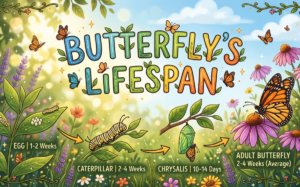
Butterfly Life Cycle
Here are 10 interesting facts about a butterfly’s lifespan (from birth to death):
🦋 1. Life Starts as a Tiny Egg
A butterfly begins its life as a very small egg, usually laid on the underside of leaves.
🐛 2. Caterpillar Stage is All About Eating
After hatching, it becomes a caterpillar (larva), whose main job is to eat continuously and grow rapidly.
🍃 3. Rapid Growth Phase
In just a few weeks, a caterpillar can grow 100 times its original size.
🧱 4. Chrysalis (Pupa) Transformation
The caterpillar forms a chrysalis (pupa), where it undergoes a magical transformation called metamorphosis.
🔬 5. Body Completely Rebuilds
Inside the chrysalis, the butterfly’s body breaks down into a liquid-like state and rebuilds into a new form.
🌸 6. Adult Butterfly Emerges
After days or weeks, a fully formed butterfly emerges with wings—but it must wait for them to dry before flying.
⏳ 7. Very Short Adult Lifespan
Most adult butterflies live only 1 to 4 weeks, depending on the species.
❄️ 8. Some Live Longer
Certain species, like monarch butterflies, can live up to 6–9 months, especially during migration.
🌍 9. Life Span Depends on Environment
Weather, predators, and food availability can greatly affect how long a butterfly lives.
🔄 10. Cycle Repeats
Before dying, butterflies lay eggs, starting the cycle of life all over again.
Butterfly Habitats Around the World
Butterflies live in different environments depending on the species.
Forests
Rich biodiversity and flowering plants support many species.
Grasslands
Open fields provide nectar and breeding areas.
Mountains
Some butterflies adapt to cold mountain climates.
Deserts
Certain species survive in dry environments.
Urban Gardens
Butterflies can thrive in parks and home gardens with flowers.
Importance of Butterflies
Butterflies are not only beautiful but also essential for ecosystems.
Pollination
Butterflies transfer pollen between flowers while feeding on nectar.
Food Chain
Butterflies and caterpillars provide food for birds, reptiles, and insects.
Environmental Indicators
Butterflies indicate the health of ecosystems because they are sensitive to environmental changes.
Scientific Research
Researchers study butterflies to understand evolution, genetics, migration, and climate change.
Butterfly Migration
Some butterflies travel huge distances.
Monarch Migration
Monarch butterflies migrate from Canada and the United States to Mexico.
Distance
Up to 4,800 kilometers.
Purpose
To escape cold winter temperatures.
Amazing Fact
Several generations complete the migration cycle.
Butterfly Defense Mechanisms
Butterflies use many survival techniques.
Camouflage
Some species blend into leaves or bark.
Mimicry
Certain butterflies imitate poisonous species.
Eye Spots
Large patterns scare predators.
Toxic Chemicals
Some butterflies become poisonous by feeding on toxic plants.
Difference Between Butterflies and Moths
Many people confuse butterflies with moths.
| Butterfly | Moth |
| Active during the day | Mostly active at night |
| Club-shaped antennae | Feathered antennae |
| Slender body | Thick furry body |
| Rest with wings upright | Rest with wings flat |
Butterfly Species by Region
Butterflies of Asia
- Common Mormon
- Blue Tiger
- Lime Butterfly
Butterflies of Africa
- African Monarch
- Citrus Swallowtail
Butterflies of Europe
- Small Tortoiseshell
- Peacock Butterfly
Butterflies of North America
- Monarch Butterfly
- Painted Lady
Butterflies of South America
- Blue Morpho
- Glasswing Butterfly
Butterflies in Pakistan
Pakistan is home to many beautiful butterfly species because of its diverse climate and landscapes.
Common Pakistani Butterflies
- Plain Tiger Butterfly
- Common Jezebel
- Lime Butterfly
- Peacock Pansy
Butterfly Habitats in Pakistan
- Northern mountain valleys
- Punjab gardens and fields
- Sindh agricultural areas
- Forest regions of Khyber Pakhtunkhwa
Butterflies are especially active during spring and summer.
Climate Change and Butterfly Decline
Climate change is affecting butterfly populations worldwide.
Major Threats
Rising Temperatures
Butterflies struggle to survive in extreme heat.
Habitat Destruction
Urbanization destroys breeding grounds.
Pesticides
Chemicals kill butterflies and caterpillars.
Pollution
Air and water pollution harm ecosystems.
Butterfly Conservation Efforts
Governments and environmental organizations are working to protect butterflies.
Protected Areas
National parks and reserves preserve habitats.
Butterfly Gardens
Special gardens provide nectar plants.
Organic Farming
Reducing pesticide use helps butterflies survive.
Public Awareness
Educational campaigns encourage conservation.
How to Attract Butterflies to Your Garden
Creating a butterfly-friendly garden is simple.
Plant Nectar Flowers
- Lavender
- Marigold
- Sunflower
- Zinnia
Provide Water
Butterflies need shallow water sources.
Avoid Pesticides
Chemical-free gardens are safer.
Grow Host Plants
Caterpillars need specific leaves for food.
Amazing Facts About Butterflies
- Butterflies taste with their feet.
- Some butterflies can see ultraviolet light.
- The largest butterfly is the Queen Alexandra’s Birdwing.
- Butterflies cannot fly if their body temperature is too low.
- A butterfly’s wings are covered with tiny scales.
- Some species live only a few weeks.
- Monarch butterflies migrate thousands of kilometers.
- Butterflies existed before humans evolved.
- Caterpillars eat much more than adult butterflies.
- Certain butterflies communicate using chemical signals.
Economic Importance of Butterflies
Butterflies contribute to tourism and education.
Eco-Tourism
Butterfly parks attract tourists worldwide.
Photography and Art
Butterflies inspire artists and photographers.
Scientific Value
Butterflies help researchers study ecosystems.
Butterfly Symbolism in Modern Society
Butterflies symbolize:
- Transformation
- Freedom
- Beauty
- Spiritual growth
- Hope
They are commonly used in fashion, jewelry, tattoos, literature, and decorations.
Future of Butterflies
Scientists warn that many butterfly species may disappear if environmental damage continues. Conservation efforts, sustainable farming, and habitat restoration are essential for protecting butterfly populations.
Technology and scientific research are helping experts monitor butterfly migrations and breeding patterns. Many countries are now creating butterfly sanctuaries and awareness programs to protect these important insects.
Conclusion
Butterflies are extraordinary creatures that bring beauty and balance to nature. From tiny eggs to graceful flying insects, their life journey is one of the most remarkable transformations in the animal kingdom. With thousands of species living across forests, mountains, gardens, and rainforests, butterflies continue to fascinate scientists and nature lovers alike.
However, butterflies face serious threats from climate change, pollution, habitat destruction, and pesticide use. Protecting butterflies is not only important for preserving biodiversity but also for maintaining healthy ecosystems.
By planting flowers, reducing chemical use, and supporting conservation efforts, people can help ensure that future generations continue to enjoy the beauty and wonder of butterflies. As symbols of hope, transformation, and nature’s creativity, butterflies remain one of the most beloved insects on Earth.
❓ Frequently Asked Questions (FAQs)
🦋 How long does a butterfly live from birth to death?
A butterfly’s complete lifespan—from egg to adult death—usually ranges from 3 to 8 weeks. However, some species, like monarch butterflies, can live up to 6–9 months, especially during migration periods.
🥚 How long does the egg stage last?
The egg stage typically lasts 3 to 10 days, depending on the species and environmental conditions such as temperature and humidity.
🐛 What does a caterpillar eat?
Caterpillars mainly eat leaves of host plants where they are born. Some species are very selective and only feed on specific plants, which is crucial for their survival.
🧱 How long does the chrysalis stage take?
The chrysalis (pupa) stage usually lasts 1 to 2 weeks, but in some cases, especially in colder climates, it can last several months.
🌸 What do adult butterflies eat?
Adult butterflies primarily feed on flower nectar, but they may also consume tree sap, rotting fruit, and minerals from soil or water sources.
🌍 Why do butterflies have such short lifespans?
Butterflies have short lifespans because their life cycle is designed for rapid reproduction and transformation. Environmental factors and predators also play a role in limiting their lifespan.
🦋 Do all butterflies go through metamorphosis?
Yes, all butterflies undergo complete metamorphosis, which includes four stages: egg, larva (caterpillar), pupa (chrysalis), and adult.
🌱 How can we help increase butterfly lifespan?
You can help butterflies live longer by planting nectar-rich flowers, avoiding pesticides, and creating a butterfly-friendly garden with host plants.
❄️ Can butterflies survive in winter?
Some butterflies migrate to warmer regions, while others survive winter in the chrysalis stage or as larvae, depending on the species.
🔄 What is the most important stage in a butterfly’s life?
Each stage is important, but the caterpillar stage is crucial because it stores the energy needed for transformation and survival as an adult butterfly.