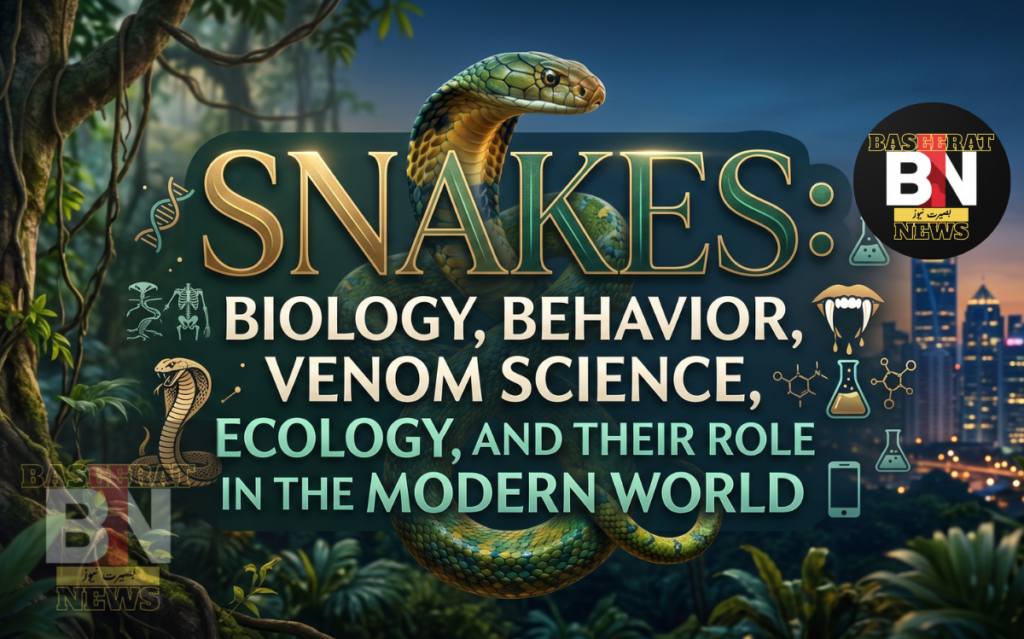
Snakes: Biology, Behavior, Venom Science, Ecology, and Their Role in the Modern World
Snakes are among the most misunderstood yet scientifically fascinating animals on Earth. With over 3,900 species worldwide, snakes inhabit nearly every ecosystem—from deserts and forests to oceans. Recent scientific advancements (2025–2026) have significantly expanded our understanding of snake biology, venom evolution, ecological roles, and even technological applications.
This article explores all major aspects of snakes, combining the latest research, real-world applications, and practical insights.
1. Biological Overview of Snakes
Snakes belong to the suborder Serpentes, within the reptile class. They evolved from lizard-like ancestors over 100 million years ago.
Key Characteristics:
- Limbless, elongated bodies
- Flexible jaws allow for large prey consumption
- Scales covering the body
- Ectothermic (cold-blooded)
A 2025 genomic study highlights that snakes show extreme diversity in body size and adaptability, driven by genetic evolution.
Size Range:
- Small: Thread snakes (~10 cm)
- Large: Reticulated python (over 6 meters)
2. Evolution and Adaptation
2.1 Evolutionary Origins
Snakes evolved through:
- Loss of limbs
- Development of elongated bodies
- Specialized feeding mechanisms
Genomic research reveals that body size evolution in snakes is controlled by complex genetic mechanisms, influencing their ecological roles.
2.2 Defensive Adaptations
A 2026 study shows that snakes evolved hidden color signals and warning patterns to deter predators.
Examples:
- Camouflage (blending with surroundings)
- Bright warning colors (venomous species)
- Mimicry (harmless snakes copying dangerous ones)
3. Types of Snakes
3.1 Non-Venomous Snakes
- Constrictors (e.g., pythons)
- Kill prey by suffocation
3.2 Venomous Snakes
- Use venom to immobilize prey
- Include:
- Cobras
- Vipers
- Sea snakes
4. Snake Venom: Science and Medical Importance
Snake venom is one of the most researched biological substances today.
4.1 Composition of Venom
Venom is a complex mixture of:
- Proteins
- Enzymes
- Toxins
A 2025 study revealed that venom evolves through genetic diversification mechanisms, allowing snakes to adapt to different prey.
Another study highlights that venom production varies within species due to gene regulation differences, showing high biological complexity.
4.2 Evolution of Venom
Research shows venom adapts to specific environments and prey types.
Recent findings indicate:
- Isolated snake populations develop simpler, prey-specific venom
- Venom is shaped by ecological needs rather than randomness
4.3 Medical Applications
Snake venom has major medical uses:
Current Applications:
- Painkillers
- Blood pressure medications
- Anti-clotting drugs
Future Potential:
A 2025 study explores venom components in drug discovery and biomedical research.
4.4 Antivenom Breakthroughs
Snakebite is a global health issue:
- ~3 million bites annually
- ~138,000 deaths per year
Recent breakthroughs include:
- Broad-spectrum antivenoms using nanobodies
- Effective against multiple species
👉 This could revolutionize snakebite treatment worldwide.
5. Behavior and Hunting Strategies
5.1 Hunting Techniques
Snakes use various hunting methods:
- Ambush predation
- Constriction
- Venom injection
A 2025 study on snake strikes shows that venomous snakes have high-speed, highly precise attack mechanics.
5.2 Feeding Behavior
Snakes can:
- Swallow prey larger than their head
- Digest slowly over days or weeks
Recent research also shows that cannibalism is more common than previously believed, occurring across many species.
5.3 Movement and Locomotion
Snakes move in several ways:
- Slithering
- Sidewinding (desert species)
- Climbing
- Swimming
A 2025 study on sea snakes found they use “wiggle and glide” diving strategies for efficient underwater hunting.
6. Intelligence and Sensory Systems
6.1 Sensory Adaptations
Snakes rely on:
- Heat-sensing pits (in some species)
- Vibration detection
- Chemical sensing via the tongue
These systems compensate for their relatively poor vision.
6.2 Intelligence
Snakes are not highly social or cognitively complex compared to mammals, but they are:
- Efficient problem-solvers in survival contexts
- Highly specialized predators
Research in reptiles suggests environment enrichment affects brain development, indicating behavioral flexibility.
7. Ecology and Environmental Role
7.1 Role in Ecosystems
Snakes are critical for ecological balance:
Key Roles:
- Control rodent populations
- Maintain food chain balance
- Serve as prey for other animals
7.2 Biodiversity Indicators
Snakes are sensitive to environmental changes.
A 2025 study highlights that:
- Over 28% of species face extinction risk due to environmental changes
👉 This makes them important indicators of ecosystem health.
7.3 Predator-Prey Dynamics
Snake populations influence:
- Rodent populations
- Agricultural ecosystems
A modeling study shows that disrupting snake populations can lead to ecological imbalance and unintended consequences.
8. Human-Snake Interaction
8.1 Fear and Misconceptions
Snakes are often feared due to:
- Venomous species
- Cultural myths
However:
- Most snakes are harmless
- Bites usually occur due to human interference
8.2 Snakebite Crisis
Snakebite is classified as a neglected tropical disease.
High-Risk Regions:
- South Asia
- Africa
- Southeast Asia
8.3 Conservation Efforts
Efforts include:
- Habitat protection
- Public education
- Medical advancements
9. Technological Innovations Inspired by Snakes
9.1 Robotics
Snake movement inspires:
- Search-and-rescue robots
- Medical devices
9.2 AI and Detection Systems
A 2025 study introduced an AI model capable of:
- Detecting snakes in natural environments
- Improving safety and conservation efforts
10. Climate Change and Future Challenges
10.1 Habitat Loss
- Urbanization reduces snake habitats
10.2 Climate Impact
- Alters snake distribution
- Increases human-snake encounters
10.2 Conservation Challenges
- Lack of funding
- Negative public perception
11. Cultural and Symbolic Importance
Snakes have deep cultural meanings:
Symbolism:
- Danger
- Wisdom
- Transformation
In South Asia:
- Religious significance
- Traditional beliefs
12. Key Insights Summary
🧬 Scientific Importance
- Venom research is advancing medicine
🌍 Ecological Role
- Essential for ecosystem balance
⚠️ Global Health Impact
- Snakebites remain a major issue
🤖 Innovation
- Inspiring robotics and AI
13. Conclusion
Snakes are far more than dangerous reptiles—they are biologically advanced, ecologically vital, and scientifically valuable creatures. Modern research has revealed their complex venom systems, evolutionary adaptations, and critical role in maintaining ecosystem balance.
From life-saving medical discoveries to cutting-edge robotics, snakes continue to influence science and technology in surprising ways. However, challenges such as climate change, habitat loss, and human fear threaten their survival.
👉 Understanding snakes is not just about science—it’s about protecting biodiversity and improving human health worldwide.