History of the United States of America — From Colonies to Global Superpower
The story of the United States is not just the story of a country. It is the story of revolution, ambition, migration, conflict, innovation, and survival. Few nations in modern history have transformed as rapidly or influenced the world as deeply as the United States of America.
Long before skyscrapers rose over New York and before Hollywood shaped global entertainment, the land that became America was home to millions of Indigenous people. Vast civilizations existed across forests, deserts, mountains, and rivers. These communities had cultures, trade networks, governments, and spiritual traditions that flourished for thousands of years.
Then came European explorers.
What began as small coastal settlements in the 1600s slowly turned into colonies controlled by Britain. Over time, tensions grew between colonists and the British Crown. Taxes increased. Anger spread. Protest movements formed. By the late eighteenth century, ordinary farmers, merchants, writers, and soldiers were demanding something extraordinary: independence.
The American Revolution changed world history forever.
The United States emerged as a new republic built on ideas of liberty and democracy. Yet the nation carried deep contradictions from the very beginning. While speaking of freedom, slavery continued to expand. While promising equality, Native Americans were pushed from their lands. The country grew quickly, but growth often came through war, displacement, and division.
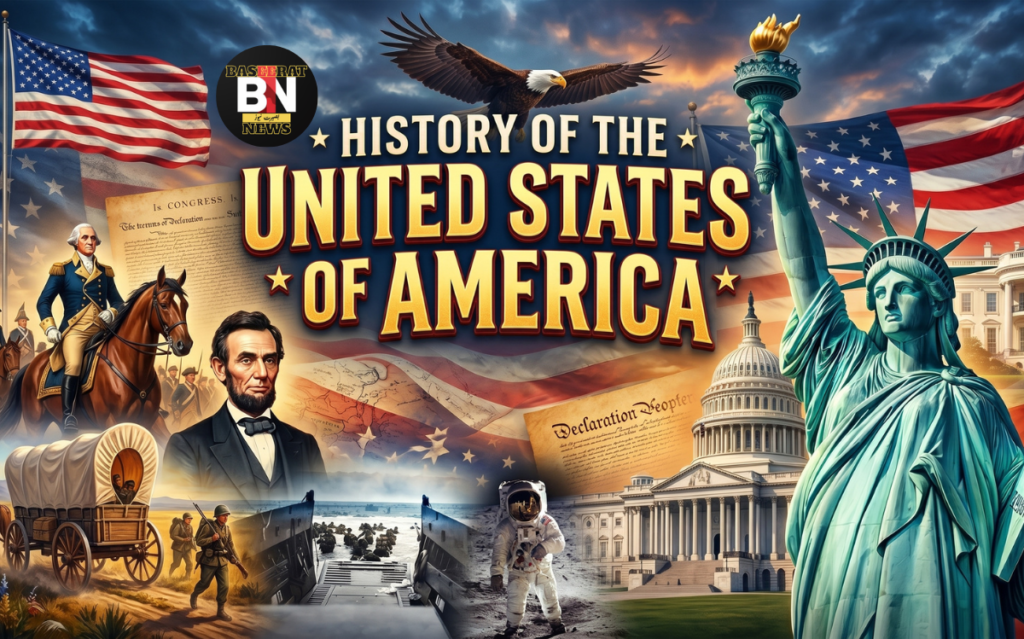
Over the next two centuries, America survived a bloody civil war, expanded westward, became an industrial giant, fought in two world wars, landed humans on the Moon, and eventually became one of the most powerful nations on Earth.
Its history includes inspiring achievements and painful struggles. It is a nation shaped by immigrants, inventors, activists, soldiers, workers, artists, and dreamers. Every decade added a new chapter — some heroic, some controversial, all unforgettable.
Today, the United States stands as a cultural, military, technological, and economic force that influences nearly every corner of the planet. But to understand modern America, one must first travel through the long and dramatic road that created it.
This is the history of the USA.
Introduction
The United States of America, often called the USA or simply America, is one of the youngest major powers in world history. Despite being officially founded in 1776, the nation rose within a few centuries to become a global superpower with immense influence over politics, technology, entertainment, trade, and military affairs.
Located in North America, the United States today consists of fifty states and a population made up of people from nearly every culture and ethnicity in the world. English is the dominant language, but America has always been shaped by diversity. Millions of immigrants from Europe, Asia, Africa, and Latin America contributed to building the country’s economy and identity.
The roots of American history stretch far beyond independence. Before European arrival, Indigenous civilizations thrived across the continent for thousands of years. Tribes such as the Cherokee, Apache, Navajo, Sioux, and Iroquois developed rich societies and deep spiritual connections to the land.
In the late fifteenth century, European exploration changed the future of the continent. Spain, France, the Netherlands, and Britain all competed for territory and trade. Eventually, Britain established thirteen colonies along the eastern coast. These colonies became the foundation of the future United States.
Life in colonial America was difficult but full of opportunity. Settlers farmed the land, built towns, and developed local governments. Over time, many colonists began to feel disconnected from British authority. Economic restrictions and unfair taxation fueled growing resentment.
The turning point came after the Seven Years’ War, when Britain attempted to tighten control over the colonies. Protest movements emerged. Events like the Boston Tea Party symbolized rising anger. By 1775, armed conflict had begun.
On July 4, 1776, the Declaration of Independence announced the birth of a new nation. Led by figures such as George Washington, Thomas Jefferson, Benjamin Franklin, and John Adams, the colonies fought for freedom from British rule.
Victory in the Revolutionary War marked the beginning of a new experiment in democracy. The United States Constitution established a federal government and created systems still used today. However, major challenges remained. Slavery divided the nation. Native populations faced displacement. Political disagreements threatened unity.
Throughout the nineteenth century, America expanded westward across the continent. Railroads connected distant territories. Gold rushes attracted fortune seekers. Industries transformed cities into economic centers. Immigration increased rapidly.
Yet expansion also intensified tensions over slavery, leading to the American Civil War in 1861. The conflict became one of the deadliest wars in American history. The Union victory preserved the nation and ended slavery, but the country remained deeply divided.
The twentieth century pushed America onto the global stage. The United States fought in World War I and World War II, emerged as a military superpower, and entered a long Cold War with the Soviet Union. American culture spread worldwide through cinema, music, television, and technology.
Modern America continues to evolve. It faces debates over politics, race, immigration, healthcare, and economic inequality. At the same time, it remains a center of innovation and global influence.
The history of the United States is complex and often dramatic. It is a story of freedom and conflict, progress and struggle, ambition and resilience. Understanding that journey helps explain not only America itself but also much of the modern world.
The First People of America
Long before Europeans arrived, North America was home to millions of Indigenous people. These communities lived across vast regions and developed unique cultures adapted to their environments.
Native American societies were highly diverse. Some tribes were nomadic hunters, while others built permanent settlements and practiced agriculture. In the Southwest, Pueblo communities constructed advanced stone dwellings. In the eastern woodlands, the Iroquois Confederacy created a sophisticated political alliance that influenced democratic ideas later admired by American founders.
Many tribes traded goods over enormous distances. Corn, beans, pottery, animal skins, and tools moved through complex trade routes. Spiritual traditions played a central role in daily life, connecting people closely with nature and ancestors.
When European explorers arrived, disease became one of the greatest tragedies for Indigenous populations. Smallpox, measles, and influenza spread rapidly among communities with no immunity. Millions died over the following centuries.
Despite resistance, Native Americans gradually lost land as European settlements expanded. Wars, forced removals, broken treaties, and violent conflicts transformed Indigenous life forever.
Even today, Native American history remains a vital part of the American story.
European Exploration and Colonization
The arrival of Europeans in North America changed the continent permanently.
In 1492, the voyage of Christopher Columbus opened the Americas to European exploration. Spain quickly built colonies across Central and South America. France explored Canada and the Mississippi River region. The Dutch established trading centers. Britain focused on the Atlantic coast.
The first permanent English settlement in North America was Jamestown, founded in Virginia in 1607. Life there was extremely difficult. Disease, hunger, and conflict killed many settlers during the early years.
In 1620, the Pilgrims arrived on the Mayflower and established Plymouth Colony in present-day Massachusetts. Seeking religious freedom, they became symbols of early colonial America.
Over time, thirteen British colonies formed along the eastern coast. Each colony developed differently. Northern colonies emphasized trade, shipbuilding, and small farms. Southern colonies relied heavily on plantation agriculture and enslaved labor.
Tobacco became a major cash crop in Virginia and the surrounding areas. As plantations expanded, slavery became deeply embedded in the colonial economy.
Colonial society slowly grew more independent. Local assemblies handled many political matters, and colonists developed a distinct American identity separate from Britain.
The Road to Revolution
By the mid-1700s, tensions between Britain and the colonies increased sharply.
After the expensive Seven Years’ War, Britain imposed new taxes on the colonies to recover costs. Measures such as the Stamp Act and the Tea Act angered colonists who believed they were being taxed without representation in Parliament.
Protests spread across the colonies. Groups like the Sons of Liberty organized resistance. The slogan “No taxation without representation” became a powerful rallying cry.
One of the most famous events occurred in 1773 when protesters dumped British tea into Boston Harbor. The Boston Tea Party shocked British authorities and led to harsher punishments.
Instead of calming tensions, British actions united many colonists against the Crown.
In 1775, fighting broke out at Lexington and Concord. The American Revolutionary War had begun.
The American Revolution
The Revolutionary War was both a military conflict and a political transformation.
George Washington became commander of the Continental Army. Although the colonists lacked resources and training compared to Britain, they possessed determination and local support.
On July 4, 1776, the Declaration of Independence formally announced separation from Britain. Written mainly by Thomas Jefferson, the document declared that all men were created equal and possessed natural rights.
The war lasted eight difficult years. American forces suffered harsh winters, shortages, and defeats. Yet victories at Saratoga and Yorktown changed the course of the conflict.
France eventually joined the war on the American side, providing critical military support.
In 1783, Britain officially recognized American independence through the Treaty of Paris.
The United States had been born.
Building a New Nation
Winning independence was only the beginning. The new nation faced enormous uncertainty.
The Articles of Confederation created a weak central government that struggled to manage economic problems and political disagreements. Leaders soon realized a stronger system was necessary.
In 1787, delegates gathered in Philadelphia to draft the United States Constitution. The Constitution established three branches of government — executive, legislative, and judicial — designed to balance power.
George Washington became the first president in 1789.
The Bill of Rights, added shortly afterward, protected freedoms such as speech, religion, and fair trials.
Despite these achievements, slavery remained unresolved. Southern states depended heavily on enslaved labor, while many northern states began moving toward abolition.
The contradiction between liberty and slavery would eventually lead to a national crisis.
Westward Expansion and Manifest Destiny
During the nineteenth century, the United States expanded rapidly westward.
In 1803, President Thomas Jefferson purchased massive territory from France in the Louisiana Purchase. This doubled the size of the nation almost overnight.
Explorers Meriwether Lewis and William Clark mapped western lands, opening routes for settlers and traders.
Many Americans believed in “Manifest Destiny,” the idea that the nation was destined to expand across the continent. Settlers moved west in search of farmland, gold, and opportunity.
This expansion often came at a terrible cost for Native Americans. Tribes were pushed from ancestral lands through treaties, warfare, and forced relocation.
One of the darkest events was the Trail of Tears during the 1830s. Thousands of Cherokee people died while being forced westward by the U.S. government.
Meanwhile, tensions with Mexico led to the Mexican-American War. After victory, the United States gained vast territories including California, Arizona, New Mexico, and Nevada.
Gold discovered in California in 1848 triggered a massive migration westward and accelerated economic growth.
Slavery and Growing Division
As the nation expanded, debates over slavery intensified.
Southern states depended on plantations growing cotton, tobacco, and sugar. Enslaved Africans and their descendants provided the labor that fueled this economy.
In the North, industrialization expanded rapidly, and anti-slavery movements gained strength. Abolitionists argued that slavery was morally wrong and demanded its end.
Figures like Frederick Douglass and Harriet Tubman became powerful voices against slavery. Tubman helped enslaved people escape through the Underground Railroad.
Political compromises temporarily delayed conflict, but tensions kept rising. The question became unavoidable: would new territories allow slavery or ban it?
The election of Abraham Lincoln in 1860 pushed the country toward crisis. Southern states feared slavery would eventually be abolished and began leaving the Union.
The nation moved toward civil war.
The American Civil War
The Civil War began in 1861 and became the deadliest conflict in American history.
The Union, led by northern states, fought to preserve the nation. The Confederacy, formed by southern states, fought largely to protect slavery and states’ rights.
The war devastated cities, farms, and families. Battles such as Gettysburg and Antietam caused enormous casualties.
President Abraham Lincoln gradually transformed the war into a fight against slavery. In 1863, he issued the Emancipation Proclamation, declaring enslaved people in Confederate territories free.
After four brutal years, the Union achieved victory in 1865.
Slavery was officially abolished through the Thirteenth Amendment.
Only days after the war ended, Lincoln was assassinated, shocking the nation.
The Civil War preserved the United States but left deep scars that would influence American society for generations.
Reconstruction and Industrial Growth
After the Civil War, the United States entered the Reconstruction era.
The government attempted to rebuild the South and integrate formerly enslaved people into society. African Americans briefly gained political rights and representation.
However, resistance in the South remained strong. Segregation laws and racial violence emerged, limiting Black Americans’ freedoms for decades.
At the same time, America experienced explosive industrial growth.
Railroads connected the nation from coast to coast. Factories expanded rapidly. Cities like Chicago, Pittsburgh, and New York became industrial centers.
Millions of immigrants arrived from Europe seeking jobs and opportunities. Many worked long hours in dangerous conditions.
Industrial leaders such as Andrew Carnegie and John D. Rockefeller built enormous fortunes. America became one of the world’s leading economic powers.
Yet economic inequality also increased dramatically.
Immigration and the American Dream
Between the late nineteenth and early twentieth centuries, millions of immigrants entered the United States.
People came from Ireland, Italy, Germany, Eastern Europe, China, and many other regions. They arrived seeking freedom, jobs, and better lives.
Ellis Island in New York became one of the most famous immigration centers in history.
Immigrants helped build railroads, factories, and cities. They introduced new foods, languages, traditions, and religions that transformed American culture.
The phrase “American Dream” became popular — the belief that hard work could create success regardless of background.
However, immigrants often faced discrimination and difficult living conditions. Many communities experienced poverty and social tension.
Despite challenges, immigration became one of the defining forces of American identity.
World War I and America’s Rise
When World War I began in 1914, the United States initially remained neutral.
However, German submarine attacks and political tensions eventually pushed America into the war in 1917.
American troops and resources helped the Allied powers achieve victory.
After the war, the United States emerged stronger economically and politically. New industries expanded rapidly during the 1920s.
Jazz music, cinema, automobiles, and consumer culture transformed American society. Cities modernized quickly.
But beneath the prosperity, economic problems were growing.
The Great Depression
In 1929, the stock market crashed, triggering the Great Depression.
Banks failed. Businesses collapsed. Millions of Americans lost jobs, homes, and savings.
Breadlines and poverty became common across the country. Farmers suffered severe hardship during the Dust Bowl environmental disaster.
President Franklin D. Roosevelt introduced the New Deal, a series of programs designed to create jobs and stabilize the economy.
Government involvement in economic life expanded significantly during this period.
The Great Depression reshaped American politics and society forever.
World War II and Global Leadership
World War II transformed the United States into a true global superpower.
After the Japanese attack on Pearl Harbor in 1941, America entered the war. Millions of Americans joined the military or worked in factories supporting the war effort.
The United States fought in Europe against Nazi Germany and in the Pacific against Japan.
American industry produced enormous quantities of weapons, aircraft, ships, and supplies. The country became known as the “Arsenal of Democracy.”
In 1945, the United States dropped atomic bombs on Hiroshima and Nagasaki, leading to Japan’s surrender and the end of the war.
The war changed global politics dramatically. Europe was weakened, while the United States and the Soviet Union emerged as rival superpowers.
The Cold War Era
After World War II, tensions between America and the Soviet Union shaped global politics for decades.
The Cold War was not a direct war between the two nations but a struggle for influence, ideology, and military power.
The United States promoted capitalism and democracy, while the Soviet Union supported communism.
Both countries built massive nuclear arsenals. Fear of nuclear war became part of daily life.
The Space Race symbolized this competition. In 1969, the United States achieved a historic victory when Apollo 11 landed humans on the Moon.
America also fought proxy wars in Korea and Vietnam.
Domestically, the Cold War era saw intense political fear, anti-communist investigations, and rapid technological advancement.
The Civil Rights Movement
During the mid-twentieth century, African Americans intensified demands for equality and justice.
Segregation laws in the South enforced racial separation in schools, transportation, and public spaces.
Civil rights leaders organized protests, boycotts, and marches challenging discrimination.
Martin Luther King Jr. became the most famous voice of the movement. His speeches inspired millions.
The Civil Rights Movement achieved major victories with the Civil Rights Act of 1964 and the Voting Rights Act of 1965.
Although racial inequality did not disappear, the movement transformed American society and expanded democratic rights.
America in the Late Twentieth Century
By the 1980s and 1990s, the United States dominated global economics, technology, and entertainment.
Hollywood movies, television, fast food, and music spread American culture worldwide.
The Cold War officially ended in 1991 after the collapse of the Soviet Union.
The rise of computers and the internet launched a technological revolution centered largely in America’s Silicon Valley.
At the same time, political debates over healthcare, immigration, gun rights, and foreign policy continued shaping national life.
America remained influential but increasingly divided on many social issues.
Modern USA
The modern United States is one of the world’s most powerful and influential countries. Its economy, military, universities, technology companies, and entertainment industry shape global trends every day.
Cities such as New York, Los Angeles, Chicago, Houston, and San Francisco have become international centers of finance, media, and innovation. American companies transformed the digital world through smartphones, social media, artificial intelligence, and advanced computing.
The nation remains highly diverse. Millions of immigrants continue arriving from around the world, contributing to business, science, education, and culture. American food, music, sports, and films are recognized almost everywhere on Earth.
However, modern America also faces serious challenges.
Political polarization has increased sharply in recent years. Elections often reveal deep divisions between urban and rural populations, liberals and conservatives, and different economic classes.
Issues such as healthcare costs, inflation, gun violence, racial justice, climate change, and immigration remain major national debates.
The terrorist attacks of September 11, 2001, profoundly changed American foreign policy. The United States launched military operations in Afghanistan and Iraq, beginning long and controversial conflicts.
Meanwhile, technological advancement continues rapidly. American companies remain leaders in artificial intelligence, aerospace, biotechnology, and digital communication.
Despite criticism and internal struggles, the United States still holds enormous global influence. Its universities attract international students, its military alliances affect world politics, and its economic decisions impact global markets.
Modern America is a nation constantly redefining itself. It remains a place of opportunity for many people while continuing to wrestle with questions about equality, identity, and democracy.
Conclusion
The history of the United States is one of the most dramatic national stories in modern civilization.
From Indigenous civilizations and colonial settlements to revolution and independence, America developed through constant change and conflict. The country expanded across a continent, survived civil war, abolished slavery, industrialized rapidly, and emerged as a global superpower.
Yet American history is not simply a story of success. It is also a history marked by injustice, displacement, inequality, and political struggle. Native Americans lost ancestral lands. Millions suffered under slavery. Immigrants faced discrimination. Social movements fought long battles for equal rights.
These contradictions are central to understanding America.
One reason the United States became so influential is its ability to reinvent itself repeatedly. Each generation challenged old systems and introduced new ideas. From the Constitution to the Civil Rights Movement, Americans continually debated the meaning of freedom and democracy.
The country’s global influence expanded, especially during the twentieth century. Through military power, economic strength, scientific innovation, and popular culture, America shaped international politics and modern lifestyles in countless ways.
The United States also became a symbol for many people seeking opportunity. Immigrants from every continent contributed to building its industries, universities, and communities. This diversity became one of America’s defining characteristics.
At the same time, debates over race, immigration, healthcare, economic inequality, and political identity continue to shape modern society. The nation remains deeply dynamic, often divided, but constantly evolving.
Perhaps the most fascinating part of American history is that it never truly stands still. Every decade introduces new challenges and transformations. Technology changes society. Demographics shift. Political movements rise and fall.
The United States today is not the same country that declared independence in 1776, yet many of the original debates about liberty, equality, and power remain relevant.
Understanding the history of the USA means understanding ambition, conflict, resilience, and reinvention. It is the story of a nation that rose from colonies on the Atlantic coast to become one of the most influential countries in human history.
And its story is still being written.
Frequently Asked Questions (FAQs)
1. When was the United States founded?
The United States declared independence on July 4, 1776.
2. Who were the first people in America?
Indigenous Native American tribes lived in North America for thousands of years before Europeans arrived.
3. Why did the American Revolution happen?
Colonists opposed British taxation and control without political representation.
4. Who wrote the Declaration of Independence?
Thomas Jefferson was the main writer of the Declaration of Independence.
5. Who was the first president of the USA?
George Washington became the first U.S. president in 1789.
6. What caused the American Civil War?
The biggest cause was conflict over slavery and states’ rights.
7. When was slavery abolished in the United States?
Slavery was officially abolished in 1865 through the Thirteenth Amendment.
8. What was Manifest Destiny?
It was the belief that America was destined to expand across North America.
9. Why was the Louisiana Purchase important?
It doubled the size of the United States in 1803.
10. What was the Trail of Tears?
It was the forced relocation of Native American tribes, especially the Cherokee, during the 1830s.
11. What happened during the Great Depression?
The economy collapsed after the 1929 stock market crash, causing massive unemployment and poverty.
12. Why did America join World War II?
The United States entered the war after Japan attacked Pearl Harbor in 1941.
13. What was the Cold War?
It was a political and military rivalry between the United States and the Soviet Union after World War II.
14. Who was Martin Luther King Jr.?
He was a major leader of the American Civil Rights Movement.
15. What is the American Dream?
It is the belief that anyone can achieve success through hard work and opportunity.
16. Why is the United States considered a superpower?
Because of its military strength, economy, technology, and global influence.
17. What role did immigrants play in American history?
Immigrants helped build industries, cities, railroads, and cultural diversity.
18. What was the Boston Tea Party?
It was a protest against British taxation in 1773.
19. What are the three branches of the U.S. government?
Executive, legislative, and judicial branches.
20. What was the Civil Rights Movement?
It was a movement fighting racial segregation and discrimination in America.
21. What is the Constitution of the United States?
It is the supreme law that defines the structure of the American government.
22. What happened on September 11, 2001?
Terrorist attacks targeted the World Trade Center and the Pentagon.
23. Why is Hollywood important globally?
Hollywood became the center of the global film and entertainment industry.
24. What is Silicon Valley?
A major technology and innovation center in California.
25. Why is U.S. history important globally?
Because American politics, economics, technology, and culture have influenced the modern world extensively.
Thank you for spending your valuable time with us.
Explore the full article now and enjoy every detail behind this incredible topic.
Complete History of the United Kingdom