Owl — The Silent Hunter of the Night Sky
The forest becomes strangely quiet after sunset.
Leaves stop rustling. Small animals freeze in place. Even the wind seems to soften for a moment.
Then, from somewhere above, two glowing eyes appear between dark branches.
No roar.
No warning cry.
Only silence.
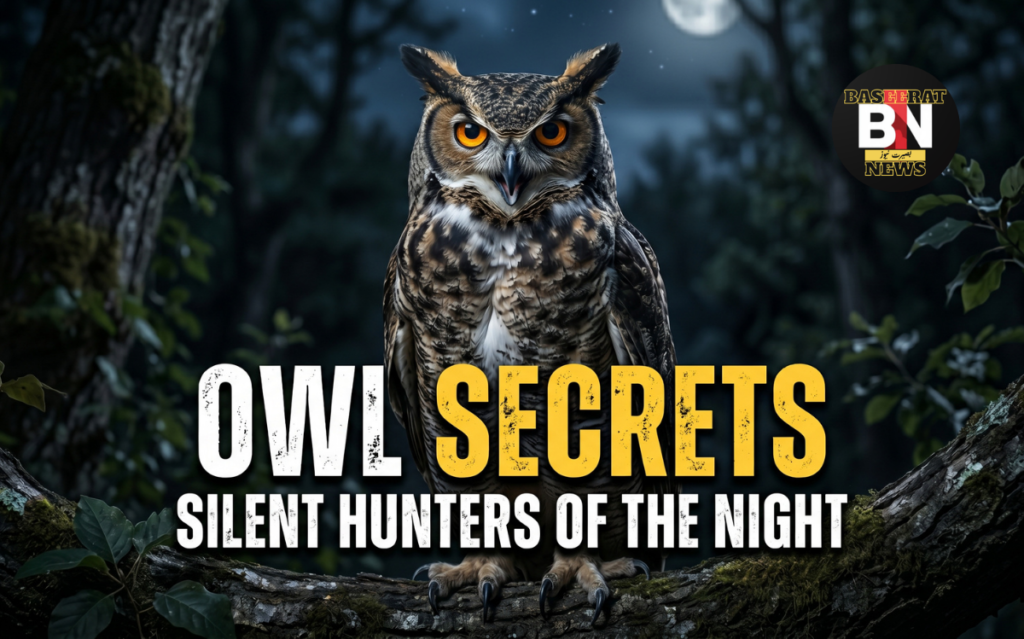
An owl glides through the night like a shadow drifting across the moon. Its wings barely make a sound. Within seconds, the hunter disappears again into darkness, leaving behind only mystery.
For thousands of years, owls have fascinated human beings. Ancient civilizations feared them, worshipped them, and turned them into symbols of wisdom, death, magic, and intelligence. Even today, hearing an owl call at night can send chills down the human spine.
But what makes owls so different from other birds?
Why do they seem almost supernatural?
And how did these silent creatures become one of the most admired animals on Earth?
This is the story of the owl — a master of darkness, an ancient predator, and one of nature’s most extraordinary survivors.
Introduction
Owls are among the most recognizable birds in the world. With their large forward-facing eyes, rotating heads, sharp talons, and ghost-like flight, they appear almost unreal. They belong to a group of birds known as raptors, meaning birds of prey.
Unlike eagles or hawks that dominate the daytime skies, owls rule the night.
Scientists have identified more than 250 species of owls across the globe. They live in deserts, rainforests, mountains, frozen tundras, grasslands, and even crowded cities. From the tiny Elf Owl standing barely taller than a coffee cup to the enormous Eurasian Eagle-Owl with wings wider than many humans are tall, owls come in remarkable forms.
Yet despite their differences, most owls share the same mysterious qualities:
silent movement,
sharp night vision,
and incredible hunting precision.
People often think owls are “wise birds,” but there is much more beneath those glowing eyes. Their bodies are engineering masterpieces designed by evolution over millions of years.
Every feather,
every bone,
and every movement serves a purpose.
Owls are not just beautiful birds. They are survival experts.
They help control rodent populations, maintain ecological balance, and support healthy ecosystems. Farmers in many regions actually depend on owls to reduce crop-destroying pests naturally.
Still, many owl species now face serious threats. Habitat destruction, climate change, pollution, and human fear continue to endanger these remarkable birds.
Understanding owls is more important than ever.
Because once you truly learn about them, the night forest never feels the same again.
The Ancient History of Owls
Long before humans built cities or wrote stories, owls already ruled the night skies.
Scientists believe owl ancestors existed over 60 million years ago. Fossils discovered in Europe and North America reveal that these birds evolved shortly after dinosaurs disappeared from Earth. While countless species vanished over time, owls survived by adapting to changing climates and environments.
That survival story alone makes them extraordinary.
Ancient humans quickly noticed owls because they behaved differently from most birds. Their nighttime activity, haunting calls, and glowing eyes created both fascination and fear.
In Ancient Greece, owls became symbols of wisdom and intelligence. The Little Owl was closely connected to Athena, the goddess of knowledge and strategy. Greek soldiers even believed seeing an owl before battle was a sign of victory.
Meanwhile, in Ancient Rome, owls were viewed very differently. Romans often considered owl cries to be warnings of death or disaster. According to historical stories, owl calls were heard before the assassinations of important leaders.
Across Asia, owls gained spiritual importance. In parts of India and China, they symbolized protection and fortune. In Japanese culture, some owl symbols still represent good luck today.
Native American tribes also held deep beliefs about owls. Some tribes respected them as protectors and messengers, while others feared them as spirits connected to the afterlife.
These mixed emotions followed owls for centuries.
Even in the Middle Ages in Europe, people associated owls with witches, haunted forests, and dark magic. Their glowing eyes in moonlight frightened travelers who lacked scientific understanding.
Yet despite myths and fear, owls quietly continued their role in nature.
Night after night,
generation after generation,
they hunted in silence beneath the stars.
And humans never stopped being fascinated by them.
Types of Owls Around the World
There are more than 250 owl species on Earth, divided mainly into two families:
- True Owls
- Barn Owls
Each species has adapted perfectly to its environment.
Some survive in frozen Arctic landscapes. Others thrive inside tropical rainforests or deserts. The variety among owls is astonishing.
Barn Owl
The Barn Owl is one of the world’s most recognizable owls. Its white, heart-shaped face looks almost ghostly under moonlight.
Barn Owls are expert rodent hunters. Farmers often welcome them because they naturally reduce rats and mice around crops and storage buildings.
Their silent flight is so smooth that prey often never hears danger approaching.
Snowy Owl
The Snowy Owl lives in Arctic regions where winter dominates most of the year. Unlike many owls, it often hunts during daylight because Arctic summers have endless sunlight.
Its thick white feathers provide camouflage against snow while also protecting it from freezing temperatures.
The species became globally famous through the owl character Hedwig in the Harry Potter and the Philosopher’s Stone series.
Great Horned Owl
Known for its ear-like feather tufts, the Great Horned Owl is one of North America’s most powerful predators.
It hunts rabbits, snakes, squirrels, and even skunks. Its grip strength is incredibly strong, allowing it to overpower surprisingly large prey.
Its deep hooting sound is one of the most iconic owl calls in the world.
Elf Owl
The Elf Owl is the smallest owl species on Earth. Some are barely 5 inches tall.
These tiny owls live mainly in desert regions and often nest inside abandoned woodpecker holes in cactus plants.
Despite their size, they are fearless hunters.
Eurasian Eagle-Owl
This giant owl is among the largest owl species alive today. Its orange eyes and massive wings create an intimidating appearance.
It can hunt animals as large as foxes and young deer in certain situations.
Watching one fly across a mountain valley feels almost prehistoric.
The Incredible Body Features of Owls
Owls are perfectly built for nighttime hunting.
Every part of their body works like specialized survival equipment.
Eyes Built for Darkness
Owls have enormous eyes compared to their body size. These eyes collect far more light than human eyes, allowing owls to see in extremely dim conditions.
Interestingly, owl eyes are not true “eyeballs.” They are tube-shaped structures fixed inside the skull.
Because they cannot move their eyes easily, owls rotate their heads instead.
Many species can turn their heads up to 270 degrees.
That ability seems supernatural, but it is actually a clever biological adaptation.
Silent Feathers
One of the owl’s greatest advantages is silent flight.
Special feather edges break up airflow and reduce sound dramatically. This allows owls to glide almost noiselessly through forests.
Scientists have even studied owl wings to improve airplane and wind turbine technology.
Nature designed silence long before humans understood aerodynamics.
Powerful Talons
Owls kill prey using strong, curved talons.
Their grip pressure can be extremely powerful, especially in larger species. Once prey is caught, escape becomes nearly impossible.
Combined with sharp beaks, owls become highly efficient predators.
Exceptional Hearing
Some owl species hear so accurately that they can hunt animals hidden beneath snow or leaves.
Their ears are often positioned unevenly on the skull. This unusual design helps determine exactly where sounds originate.
An owl can detect the tiniest movement in darkness.
Imagine hearing a mouse breathing beneath snow from several meters away.
That is the level of precision owls possess.
Hunting Skills of Owls
Owls are patient hunters.
Unlike cheetahs or wolves that rely on speed, owls rely on timing, silence, and surprise.
A hunting owl often waits quietly on a branch for long periods. The forest may appear calm, but the owl remains fully alert.
Then suddenly —
movement.
Within seconds, the owl launches itself through the darkness.
Its wings stay silent. Its eyes lock onto prey. Sharp talons extend forward at the perfect moment.
The attack is incredibly fast.
Most prey animals never realize what happened.
Owls hunt mice, rats, rabbits, insects, fish, frogs, snakes, and even other birds, depending on species size.
Some fishing owls skim across water surfaces to catch fish with their claws.
Others hunt in open grasslands using sound alone.
Snowy Owls patrol Arctic lands searching for lemmings.
Each species developed strategies suited to its environment.
That flexibility explains why owls survived for millions of years.
Owl Habitats Around the World
Owls live on nearly every continent except Antarctica.
Their adaptability is remarkable.
Forests
Dense forests provide shelter, nesting areas, and hunting grounds. Many owls blend perfectly into tree bark using camouflage feathers.
During the day, they become almost invisible.
Deserts
Desert owls survive intense heat and limited water. Species like the Elf Owl use cactus cavities for protection.
The desert may seem empty, but at night it becomes alive with hidden owl activity.
Arctic Regions
Snowy Owls dominate some of the harshest environments on Earth.
Strong feathers protect them from freezing winds, while white coloring provides camouflage against predators and prey alike.
Grasslands and Farms
Open landscapes offer excellent hunting opportunities for rodent-eating owls.
Barn Owls especially thrive near farms and agricultural areas.
Cities
Surprisingly, some owls now adapt to urban life.
City parks, abandoned buildings, and rooftops provide nesting areas. Artificial lights can attract insects and rodents, creating hunting opportunities.
Even in modern cities, the ancient hunter still survives.
What Do Owls Eat?
Owls are carnivores, meaning they eat meat.
Their diet depends heavily on species size and habitat.
Small owls mainly eat insects, beetles, spiders, and tiny rodents.
Medium-sized owls hunt mice, rats, rabbits, frogs, and birds.
Large owls may attack foxes, ducks, snakes, and other predators.
Barn Owls can consume thousands of rodents each year. This makes them extremely valuable for natural pest control.
One fascinating behavior involves owl pellets.
Owls swallow prey mostly whole. Later, they regurgitate indigestible parts like bones and fur in compact pellets.
Scientists study these pellets to learn about owl diets and ecosystems.
Inside a small gray pellet lies an entire story of nighttime hunting.
Owls in Human Culture and Mythology
Few birds have influenced human imagination like owls.
Their mysterious behavior inspired myths across nearly every civilization.
Symbols of Wisdom
Because owls appear calm and observant, many cultures associated them with intelligence.
Today, owl symbols often appear in schools, libraries, and educational logos.
The idea of the “wise owl” remains powerful worldwide.
Symbols of Fear
Not all stories were positive.
In many traditions, owl cries were believed to predict death or bad luck.
Dark forests combined with nighttime calls created fear among ancient communities.
Without scientific knowledge, people filled the unknown with superstition.
Owls in Literature and Film
Modern entertainment transformed owls into beloved characters.
From fantasy novels to animated movies, owls frequently appear as magical guides, messengers, or protectors.
The Legend of the Guardians: The Owls of Ga’Hoole introduced audiences to a fictional owl kingdom filled with bravery and adventure.
Meanwhile, the Harry Potter series turned owls into iconic magical companions.
Children who once feared owls suddenly admired them.
Threats Facing Owls Today
Despite their success over millions of years, many owl species now face danger.
Habitat Destruction
Forests continue disappearing because of urban expansion, logging, and agriculture.
Without nesting trees or hunting grounds, owl populations decline rapidly.
Traffic and Human Structures
Owls often collide with vehicles, power lines, and buildings during nighttime hunting.
Artificial lighting can also disrupt natural behaviors.
Poisoning
Rodenticides used to kill rats can indirectly poison owls that consume contaminated prey.
This hidden threat affects many species worldwide.
Climate Change
Changing temperatures alter ecosystems and prey populations.
Arctic owls especially face uncertainty as warming affects snow-covered habitats.
Protecting owls means protecting entire ecosystems.
Their survival reflects the health of the natural world itself.
Amazing Facts About Owls
Owls are filled with surprises.
Here are some incredible facts that sound almost unbelievable.
Owls Cannot Chew
They swallow prey whole or tear it into chunks.
Some Owls Hunt Fish
Fishing owls use sharp claws to snatch fish directly from the water’s surface.
Owls Have Three Eyelids
One for blinking, one for sleeping, and one for cleaning the eye.
Nature thought of everything.
Female Owls Are Often Larger
In many owl species, females outweigh males.
Scientists believe this may help protect nests and offspring.
Owl Calls Are Unique
Different species produce whistles, screeches, hoots, clicks, and even barking sounds.
Not every owl says “hoo.”
They Are Masters of Camouflage
An owl sitting against tree bark can become nearly impossible to spot.
Some disappear completely into forests.
Owls Exist Almost Everywhere
From icy tundras to tropical jungles, owls adapted to astonishing environments.
Few bird groups are so widespread.
The Relationship Between Humans and Owls
Humans share a complicated relationship with owls.
Some people admire them deeply. Others still fear them because of ancient beliefs.
Wildlife photographers travel thousands of miles just to capture a single owl image in snowfall.
Birdwatchers spend silent nights listening for distant hoots.
Farmers appreciate owls for controlling pests naturally.
Meanwhile, conservationists work tirelessly to protect endangered species.
There is something emotionally powerful about seeing an owl in the wild.
Perhaps it is the silence.
Perhaps the eyes.
Or perhaps the feeling that the bird belongs to an older world untouched by modern noise.
Owls remind humans that nature still contains mystery.
And mystery is becoming rare.
Conclusion
The story of the owl is not simply about a bird.
It is a story about survival,
adaptation,
silence,
and the hidden beauty of the natural world.
For millions of years, owls have hunted beneath moonlit skies while civilizations rose and disappeared around them. They survived ice ages, storms, changing forests, and human expansion.
Yet they remain vulnerable.
Modern life continues shrinking the wild places where owls thrive. Forests vanish. Artificial lights replace darkness. Dangerous chemicals poison the food chain.
Still, every night somewhere on Earth, an owl spreads its wings and glides silently across the shadows.
A hunter older than human history.
A symbol of mystery.
A guardian of the night.
The next time you hear an owl calling after sunset, pause for a moment.
Listen carefully.
You are hearing one of nature’s oldest voices.
Frequently Asked Questions About Owls
1. What is an owl?
An owl is a bird of prey known for nighttime hunting, silent flight, and sharp vision.
2. How many owl species exist?
Scientists recognize more than 250 owl species worldwide.
3. Are all owls nocturnal?
No. Some owls hunt during the day, especially in Arctic regions.
4. Can owls rotate their heads fully?
No. They can rotate up to about 270 degrees.
5. Why are owl eyes so large?
Large eyes help collect more light for night vision.
6. Are owls dangerous to humans?
Most owls avoid humans unless protecting nests.
7. What do owls eat?
They eat rodents, insects, birds, fish, reptiles, and small mammals.
8. Why are owl flights silent?
Special feather structures reduce sound during flight.
9. Where do owls live?
Owls live in forests, deserts, mountains, farms, and cities.
10. Do owls build nests?
Many owls use tree holes or abandoned nests instead.
11. What is the smallest owl?
The Elf Owl is the smallest known owl species.
12. What is the largest owl?
The Eurasian Eagle-Owl is among the largest species.
13. Can owls see in complete darkness?
No animal can see in total darkness, but owls see extremely well in low light.
14. Why do owls hoot?
Hooting helps communication and territory defense.
15. Are owls intelligent?
Owls are skilled hunters, though not necessarily smarter than all birds.
16. How long do owls live?
Some owls live over 20 years in the wild.
17. What are owl pellets?
They are regurgitated remains of indigestible prey parts.
18. Do owls migrate?
Some species migrate while others remain year-round residents.
19. Why do cultures fear owls?
Ancient myths linked owls to darkness and death.
20. Are owls protected by law?
Many countries legally protect owl species.
21. Can owls swim?
Some owls can swim short distances if necessary.
22. How fast can owls fly?
Flight speed varies by species, but many fly around 30–40 mph.
23. Do owls hunt during rain?
Some species continue hunting during light rain.
24. What sounds do owls make?
Owls hoot, screech, whistle, bark, and click.
25. Why are owls important?
They help control pests and maintain ecological balance.
26. Do owls mate for life?
Some owl species form long-term pair bonds.
27. Are baby owls called owlets?
Yes, young owls are called owlets.
28. Can owls hear underwater prey?
No, but they hear movements near water extremely well.
29. Why are owl eyes forward-facing?
This improves depth perception for hunting.
30. Are owls endangered?
Some species are endangered due to habitat loss and pollution.
——————————————————————————————
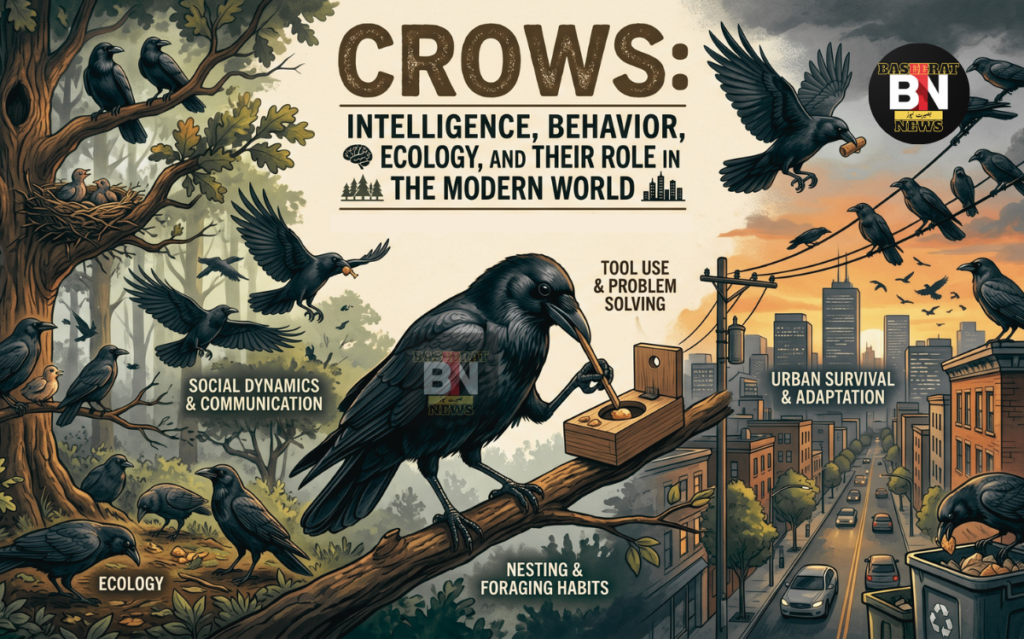
GET more knowledge about crows, just click below
https://baseeratnews.com/crows-intelligence-behavior-ecology-and-their-role-in-the-modern-world/