The History of Egypt: From the Pharaohs to the Modern Nation
Introduction: The Civilization That Defied Time
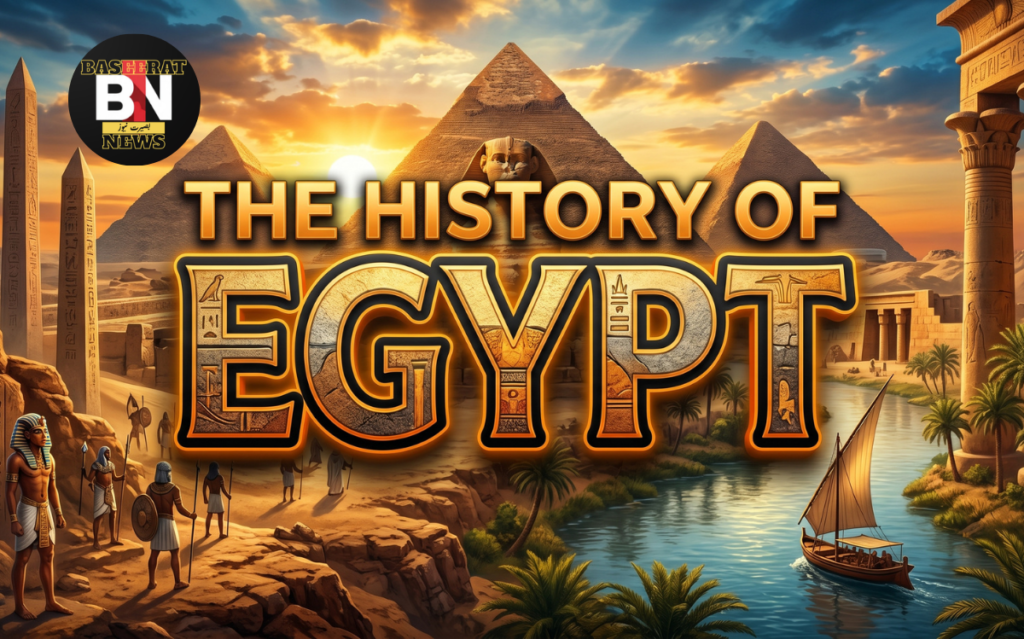
The History of Egypt is one of humanity’s longest, richest, and most fascinating stories. Long before modern nations rose across Europe, Asia, or the Americas, the banks of the Nile River gave birth to a civilization that mastered engineering, religion, mathematics, medicine, astronomy, and political organization. For more than 5,000 years, Egypt has stood as a symbol of mystery, power, and cultural brilliance.
“Long before modern nations existed, the sands of Egypt witnessed the rise of kings who believed they were gods.”
Ancient travelers looked at Egypt with wonder. Greek historians admired its temples. Roman emperors copied its monuments. Modern archaeologists continue to uncover hidden tombs and forgotten cities beneath the desert sands. Even today, the pyramids remain among the greatest architectural achievements in human history.
The story of Egyptian civilization is not simply the story of pyramids and pharaohs. It is also the story of farmers who depended on the Nile floods, priests who guarded sacred knowledge, queens who ruled powerful empires, merchants who connected Africa and Asia, and scholars who shaped science and philosophy.
Over centuries, Egypt experienced dramatic transformations:
- the rise of divine kings,
- the construction of colossal monuments,
- foreign invasions,
- Greek and Roman rule,
- the spread of Christianity and Islam,
- Ottoman control,
- European colonization,
- and finally the rise of the modern Egyptian state.
What makes Egypt unique is continuity. Few civilizations survived so many political changes while preserving such a strong cultural identity. The modern nation of Egypt still carries echoes of its ancient past in language, art, architecture, and national pride.
Today, Egypt remains central to world tourism, archaeology, Middle Eastern politics, African diplomacy, and global historical research. Every year, discoveries in tombs and temples reveal secrets hidden for thousands of years, proving that Egypt’s story is still unfolding.
Egypt History Timeline
| Period | Approximate Dates | Major Events |
| Predynastic Egypt | Before 3100 BCE | Early settlements and farming |
| Early Dynastic Period | 3100–2686 BCE | Unification under Narmer |
| Old Kingdom | 2686–2181 BCE | Pyramid Age |
| Middle Kingdom | 2055–1650 BCE | Economic revival and expansion |
| New Kingdom | 1550–1070 BCE | Egypt’s imperial golden age |
| Late Period | 664–332 BCE | Foreign invasions and instability |
| Ptolemaic Egypt | 332–30 BCE | Greek rule and Cleopatra |
| Roman Egypt | 30 BCE–641 CE | Roman and Byzantine control |
| Islamic Egypt | From 641 CE | Arab conquest and Islamic culture |
| Ottoman & British Rule | 1517–1952 | Colonial influence |
| Modern Egypt | 1952–Present | Republic and modern state |
Geography and the Importance of the Nile River
Historians often describe Egypt as:
“The Gift of the Nile.”
Without the Nile River, Ancient Egypt would never have existed. Most of Egypt is covered by harsh desert landscapes, including the Sahara Desert. Rainfall is extremely limited. Yet along the Nile Valley, fertile black soil created one of the most productive agricultural regions in the ancient world.
The Nile River flows northward through northeastern Africa before emptying into the Mediterranean Sea. Each year, seasonal floods deposited nutrient-rich silt onto the surrounding land. This natural irrigation system allowed Egyptian farmers to grow wheat, barley, flax, vegetables, and fruits in large quantities.
Recommended visuals:
The Nile influenced every aspect of Egyptian civilization:
- agriculture,
- transportation,
- trade,
- religion,
- and political unity.
Boats traveling along the Nile connected Upper Egypt in the south with Lower Egypt in the north. This transportation network encouraged trade and centralized government. Egyptian rulers could move soldiers, crops, stone, and goods efficiently across the kingdom.
The surrounding deserts also protected Egypt from many invasions. Natural barriers made large-scale attacks difficult, giving Egypt long periods of stability compared to neighboring civilizations.
Egyptians developed advanced irrigation systems to control water distribution. Farmers carefully planned planting and harvesting cycles according to the Nile’s flooding seasons. Successful harvests generated wealth that supported monumental architecture, military campaigns, and religious institutions.
The Nile also held spiritual significance. Egyptians believed the river was sacred and connected to divine forces. Many religious ceremonies honored gods associated with fertility and water.
Geography helped Egypt become a superpower because it provided:
- reliable food supplies,
- economic stability,
- defensive protection,
- and communication routes.
This combination allowed Egypt to flourish for thousands of years while many other early civilizations disappeared.
Prehistoric Egypt and Early Settlements
Before the rise of the pharaohs, prehistoric communities slowly developed along the Nile Valley. Archaeological evidence shows that hunter-gatherers lived in the region as early as 100,000 years ago. Over time, climate change pushed people toward the Nile, where water and fertile land supported permanent settlements.
Early Egyptians used:
- stone tools,
- fishing equipment,
- hunting weapons,
- and primitive farming techniques.
As agriculture expanded, villages grew larger and more organized. Communities domesticated animals such as cattle, sheep, and goats. Pottery production, weaving, and trade networks also began to emerge.
Predynastic Egypt eventually developed into two major regions:
- Upper Egypt in the south,
- Lower Egypt in the Nile Delta.
These regions had separate rulers, symbols, traditions, and political identities.
Archaeologists have uncovered burial sites revealing early religious beliefs. Many graves contained food, jewelry, pottery, and tools, suggesting belief in an afterlife long before the pyramids were built.
Recommended visuals:
Trade also expanded during this era. Egyptians exchanged goods with Nubia, the Levant, and other African regions. Imported materials included:
- gold,
- ivory,
- cedar wood,
- incense,
- and precious stones.
These early developments laid the foundation for centralized government and the rise of one of history’s first great states.
The Unification of Egypt
Around 3100 BCE, King Narmer — often identified with Menes — united Upper and Lower Egypt into a single kingdom. This event marks the beginning of dynastic Egyptian history.
Narmer established centralized authority and introduced many traditions that shaped Egyptian civilization for centuries.
The unification created:
- a national government,
- royal bureaucracy,
- taxation systems,
- military organization,
- and large-scale construction projects.
The famous Narmer Palette, discovered by archaeologists, depicts the king wearing the crowns of both Upper and Lower Egypt, symbolizing unity and royal power.
Memphis became an important political center because it sat between the two regions. From there, rulers controlled trade, agriculture, and administration.
Early dynasties also witnessed the development of hieroglyphic writing. Scribes recorded religious texts, taxes, royal decrees, and historical events. Writing became essential to maintaining a centralized government.
Egyptian kings were not viewed as ordinary rulers. Pharaohs were considered divine beings connected to the gods. This religious authority strengthened political stability and obedience.
The Old Kingdom: Age of the Pyramids
The Old Kingdom, often called the “Age of the Pyramids,” represents one of the greatest architectural periods in human history. Between approximately 2686 and 2181 BCE, Egypt achieved extraordinary political stability, economic strength, and engineering advancement.
This era is most famous for the construction of the pyramids at Giza.
Recommended visuals:
Pharaoh Khufu ordered the construction of the Great Pyramid of Giza around 2560 BCE. Originally standing about 146 meters tall, it remained the tallest man-made structure in the world for nearly 4,000 years.
The Great Pyramid required:
- millions of limestone blocks,
- skilled laborers,
- engineers,
- architects,
- and complex logistics.
Modern research shows that the pyramids were not built by slaves, as many myths claim. Archaeologists discovered workers’ villages near Giza containing housing, bakeries, medical facilities, and cemeteries. This evidence suggests that organized labor forces made up of paid workers and seasonal laborers.
The pyramids served as royal tombs designed to help pharaohs enter the afterlife. Egyptians believed death was only a transition into another existence. Preserving the body through mummification was considered essential for eternal life.
The mummification process involved:
- removing internal organs,
- drying the body with natron salt,
- wrapping it in linen,
- and placing it inside decorated coffins.
The Sphinx, another iconic monument, guarded the pyramid complex. With the body of a lion and the head of a king, it symbolized royal strength and wisdom.
Religion deeply influenced architecture. Pyramid shapes may have represented rays of sunlight connecting rulers to the sun god Ra.
Did You Know?
- The Great Pyramid contains approximately 2.3 million stone blocks.
- Some blocks weigh more than 70 tons.
- The pyramid aligns closely with the cardinal directions.
Despite centuries of study, scholars still debate exactly how the pyramids were constructed with ancient technology. Their precision continues to astonish engineers today.
Religion and Mythology in Ancient Egypt
Religion controlled nearly every aspect of Ancient Egyptian life. Egyptians believed the universe operated according to divine order known as “Ma’at,” representing truth, balance, harmony, and justice.
The pharaoh was considered the protector of Ma’at and the intermediary between humans and gods.
Egyptian mythology included hundreds of deities, but several became especially important.
Recommended visuals:
Major Egyptian Gods
Ra
The sun god and creator deity. Egyptians believed Ra traveled across the sky each day and through the underworld each night.
Osiris
God of the afterlife and resurrection. According to myth, Osiris ruled the underworld after being killed by his brother Seth.
Isis
Goddess of magic, motherhood, and healing. She became one of the most beloved Egyptian deities.
Horus
Falcon-headed god associated with kingship and the sky.
Anubis
Jackal-headed god connected with mummification and funerary rituals.
Temples served as centers of religion, economics, and education. Priests managed rituals, festivals, and offerings believed necessary to maintain cosmic order.
The Book of the Dead contained spells and instructions guiding souls through the afterlife. Egyptians believed the heart would be weighed against the feather of Ma’at. Those judged worthy entered eternal paradise.
Religion also strengthened political authority. Since pharaohs were viewed as divine rulers, challenging the king could be interpreted as opposing the gods themselves.
The Middle Kingdom and Expansion
After a period of instability known as the First Intermediate Period, Egypt reunified around 2055 BCE, beginning the Middle Kingdom.
Historians often call this era Egypt’s “classical age” because of its cultural refinement and administrative reforms.
The Middle Kingdom expanded trade and military influence into Nubia and the surrounding territories. Gold mines in Nubia increased royal wealth, while trade routes brought luxury goods into Egypt.
This period also witnessed advances in:
- literature,
- irrigation,
- architecture,
- and government organization.
Egyptian literature flourished with stories, wisdom texts, poetry, and philosophical writings. Some scholars consider Middle Kingdom literature among the finest achievements of ancient Egyptian culture.
Large irrigation projects improved agricultural productivity and economic stability. Provincial governors became more closely controlled by the central government, reducing internal conflict.
Art became more realistic during this era, reflecting deeper emotional expression and individuality.
The New Kingdom: Egypt’s Golden Age
The New Kingdom marked the peak of Egyptian military power, wealth, and international influence. From approximately 1550 to 1070 BCE, Egypt transformed into a vast empire stretching across parts of Africa and the Middle East.
Hatshepsut: The Female Pharaoh
Hatshepsut became one of the few women to rule Egypt as pharaoh. She promoted trade expeditions, monumental architecture, and economic prosperity.
Her mortuary temple at Deir el-Bahri remains one of Egypt’s architectural masterpieces.
Akhenaten and Religious Revolution
Pharaoh Akhenaten attempted to transform Egyptian religion by promoting worship of Aten, the sun disk, above all other gods. This controversial religious revolution weakened traditional priesthoods.
His son, Tutankhamun, later restored traditional religion.
Tutankhamun
Although Tutankhamun ruled briefly, he became world-famous after British archaeologist Howard Carter discovered his nearly intact tomb in 1922.
The tomb contained:
- golden treasures,
- jewelry,
- weapons,
- furniture,
- and ceremonial objects.
This discovery transformed modern understanding of Ancient Egypt.
Ramesses II
Often called Ramesses the Great, he ruled for more than sixty years and led military campaigns against the Hittites.
The famous Battle of Kadesh became one of history’s earliest recorded large-scale battles.
Ramesses II also constructed enormous monuments, including Abu Simbel.
Valley of the Kings
Instead of pyramids, New Kingdom rulers built hidden tombs in the Valley of the Kings to prevent robbery.
These tombs contained detailed paintings describing journeys through the afterlife.
Karnak Temple
The Karnak Temple complex became one of the largest religious sites ever constructed.
Massive columns, statues, obelisks, and ceremonial avenues demonstrated Egypt’s wealth and spiritual power.
The New Kingdom represented Egypt’s greatest era because it combined:
- military dominance,
- artistic achievement,
- economic prosperity,
- and global diplomacy.
Cleopatra and the Fall of Ancient Egypt
After centuries of decline and foreign invasions, Egypt came under Greek control following Alexander the Great’s conquest in 332 BCE.
The Ptolemaic dynasty ruled Egypt for nearly three centuries.
The most famous ruler of this era was Cleopatra VII.
Contrary to popular belief, Cleopatra was ethnically Macedonian Greek, not native Egyptian. However, she embraced Egyptian culture and language more than many earlier Ptolemaic rulers.
Cleopatra formed political and romantic alliances with:
- Julius Caesar,
- and later Mark Antony.
These alliances pulled Egypt into Roman civil wars.
After Antony and Cleopatra were defeated by Octavian at the Battle of Actium in 31 BCE, Egypt became a Roman province.
Cleopatra’s death in 30 BCE marked the end of independent Ancient Egypt.
Roman control transformed Egypt into a major supplier of grain for the Roman Empire.
Islamic Egypt and Medieval Transformation
In 641 CE, Arab Muslim forces conquered Egypt, introducing Islam and Arabic culture.
This event permanently transformed Egyptian identity.
Cairo eventually became one of the greatest cities in the Islamic world.
Recommended visuals:
The Fatimid Dynasty
The Fatimids established Cairo in the 10th century and founded Al-Azhar, which became one of the world’s most influential Islamic educational institutions.
The Mamluks
The Mamluks turned Egypt into a military and commercial power. They successfully resisted Mongol invasions and expanded trade networks connecting Africa, Asia, and Europe.
Ottoman Rule
The Ottoman Empire conquered Egypt in 1517. Although Egypt remained important economically and strategically, political power shifted toward Istanbul.
Islamic Egypt produced magnificent architecture, including:
- mosques,
- madrasas,
- palaces,
- and marketplaces.
The blending of Islamic traditions with older Egyptian heritage created a unique cultural identity that still shapes Egypt today.
Modern Egypt and Independence
During the 19th century, Egypt experienced modernization efforts under Muhammad Ali Pasha, who reformed the military, agriculture, and economy.
The opening of the Suez Canal in 1869 transformed global trade by connecting the Mediterranean Sea with the Red Sea.
However, increasing European influence eventually led to British occupation in 1882.
Egyptian nationalism grew throughout the early 20th century, leading to independence movements and political unrest.
In 1952, the Free Officers Movement overthrew the monarchy.
Gamal Abdel Nasser
Nasser became one of the Arab world’s most influential leaders.
He nationalized the Suez Canal in 1956, triggering the Suez Crisis involving Britain, France, and Israel.
Modern Egypt remains a key regional power in:
- Arab politics,
- African diplomacy,
- tourism,
- and Middle Eastern affairs.
Tourism centered around ancient monuments remains one of Egypt’s major economic sectors.
Archaeology and Modern Discoveries
Archaeology continues to reshape the understanding of Egyptian civilization.
In recent years, researchers have uncovered major discoveries in Luxor, Saqqara, and other ancient sites.
Recommended visuals:
Recent discoveries connected to King Thutmose II generated international attention among archaeologists and historians.
Excavations in Saqqara revealed:
- mummies,
- statues,
- painted coffins,
- and inscriptions from multiple dynasties.
Modern technologies now assist researchers through:
- ground-penetrating radar,
- 3D scanning,
- satellite imaging,
- and DNA analysis.
These tools allow archaeologists to explore hidden chambers and reconstruct ancient lifestyles more accurately than ever before.
Egyptian authorities also continue restoring temples and tombs to support tourism and preservation.
Egyptian Culture and Daily Life
Ordinary Egyptians lived highly organized lives shaped by family, religion, agriculture, and seasonal cycles.
Most people worked as farmers, craftsmen, laborers, or traders.
Food
Common foods included:
- bread,
- onions,
- fish,
- dates,
- figs,
- and beer.
Clothing
Egyptians wore lightweight linen clothing suited to the hot climate.
Medicine
Ancient Egyptian medicine was surprisingly advanced. Physicians used herbal remedies, surgical tools, and medical texts.
Education
Scribes held respected positions because literacy was rare and essential for administration.
Cosmetics and Beauty
Both men and women used cosmetics, perfumes, and jewelry. Eye makeup made from kohl protects against sunlight and infections.
Music, dance, and festivals played important roles in social life.
Egyptian culture emphasized balance, tradition, and respect for divine order.
Egypt’s Influence on the Modern World
Egypt influenced civilizations across Africa, Europe, and the Middle East.
Ancient Egyptian achievements contributed to:
- architecture,
- engineering,
- astronomy,
- medicine,
- mathematics,
- and writing systems.
Obelisks, columns, and monumental stone construction inspired later Greek and Roman architecture.
Egyptian religious ideas influenced neighboring cultures and later traditions.
Today, Egypt continues inspiring:
- films,
- novels,
- museums,
- documentaries,
- and tourism industries.
The Great Pyramid of Giza remains one of the world’s most recognizable landmarks.
Modern fascination with mummies, pharaohs, and lost tombs demonstrates Egypt’s lasting cultural power.
Ancient Egypt Myths vs Facts
| Myth | Reality |
| Slaves built the pyramids | Evidence suggests skilled laborers built them |
| Cleopatra was Egyptian | She was a Macedonian Greek |
| Pyramids were only tombs | They also symbolized royal divinity |
| Egyptians worshipped animals | Animals symbolized divine qualities |
| All pharaohs were men | Women like Hatshepsut ruled Egypt |
Top Pharaohs of Egypt
| Pharaoh | Why Famous |
| Narmer | Unified Egypt |
| Khufu | Built the Great Pyramid |
| Hatshepsut | Powerful female ruler |
| Akhenaten | Religious revolution |
| Tutankhamun | Famous tomb discovery |
| Ramesses II | Military and architectural achievements |
| Cleopatra VII | Last ruler of Ancient Egypt |
FAQs About the History of Egypt
How old is Egyptian civilization?
Egyptian civilization began around 3100 BCE after the unification of Upper and Lower Egypt.
Who built the pyramids?
Skilled Egyptian workers and laborers constructed the pyramids under royal supervision.
Why was the Nile River important?
The Nile provided fertile soil, transportation, water, and economic stability.
Who was the most powerful pharaoh?
Many historians consider Ramesses II among the most powerful rulers.
Was Cleopatra Egyptian?
Cleopatra belonged to the Greek Ptolemaic dynasty.
Why were mummies preserved?
Egyptians believed preserving the body was necessary for the afterlife.
What language did Ancient Egyptians speak?
Ancient Egyptians spoke the Egyptian language and used hieroglyphics for writing.
What religion did Ancient Egyptians follow?
They practiced a polytheistic religion centered on many gods and goddesses.
What are the newest discoveries in Egypt?
Recent discoveries include tombs in Luxor, Saqqara excavations, and hidden chambers detected with modern scanning technologies.
Why are the pyramids important?
They represent extraordinary engineering, royal authority, and spiritual beliefs.
What ended Ancient Egypt?
Roman conquest ended Egypt’s independence in 30 BCE.
Why is Cairo historically important?
Cairo became a major Islamic, political, and cultural center.
Did women have rights in Ancient Egypt?
Women could own property, inherit wealth, and sometimes rule as pharaohs.
What was the Book of the Dead?
It was a collection of spells helping souls navigate the afterlife.
Why does Egypt still fascinate people today?
Its monuments, mysteries, religion, and archaeological discoveries continue inspiring global curiosity.
Conclusion: The Eternal Legacy of Egypt
The story of Egypt is the story of human ambition, imagination, faith, and endurance. Across thousands of years, Egypt created monuments that challenged the limits of engineering, religions that shaped civilizations, and cultural achievements that still influence the modern world.
From the fertile banks of the Nile River to the golden tombs of pharaohs, Egypt built one of history’s greatest civilizations. It survived invasions, political collapse, religious transformation, and imperial conquest while continuing to preserve its unique identity.
The pyramids still rise above the desert. Temples still stand beside the Nile. Archaeologists still uncover hidden secrets buried beneath ancient sands.
Empires rose and disappeared, but Egypt continues to stand beside the Nile as one of humanity’s greatest stories.
Click for more link is below:
https://baseeratnews.com/history-of-the-united-states-of-america/
Click for more link is below:
https://baseeratnews.com/history-of-ireland/