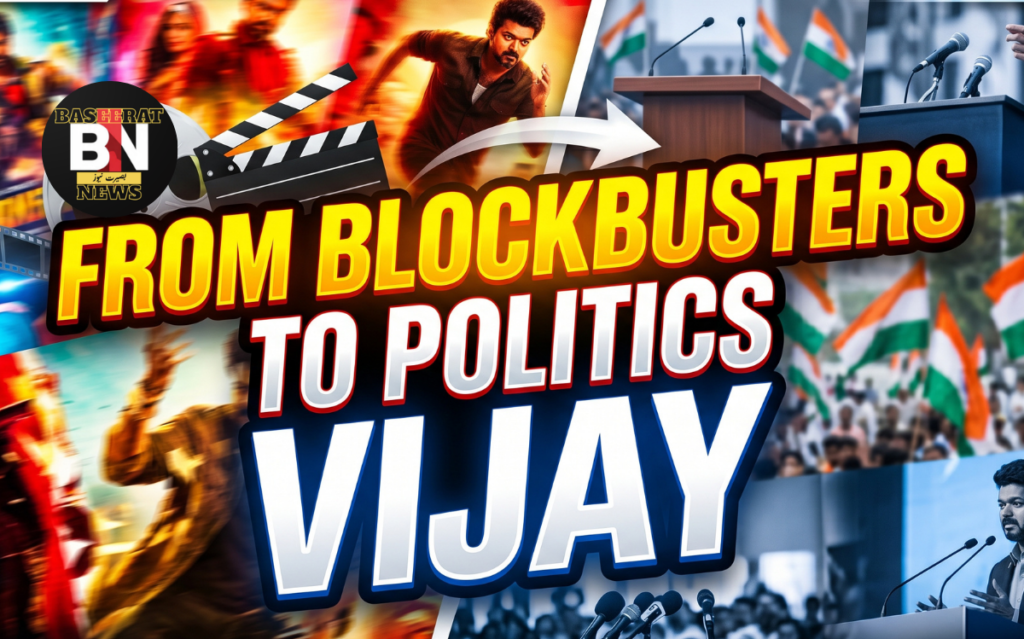
Thalapathy Vijay: The Extraordinary Journey of a Cinema Legend Turned Political Visionary
There are very few names in Indian entertainment that carry the kind of weight, warmth, and widespread admiration that Vijay does. Affectionately called “Thalapathy,” a Tamil word meaning “Commander” or “Leader” by millions of devoted fans, Vijay has spent more than three decades carving out a legacy that stretches well beyond the silver screen. His story is not simply the tale of a talented boy who became a superstar. It is the story of a man who understood the pulse of the common people, channelled their hopes and struggles into his art, and eventually answered the call of public service by stepping into the world of politics.
From the narrow lanes of Chennai where he grew up watching his father shape stories on film sets, to the thunderous applause of packed cinema halls across Tamil Nadu and the world, Vijay’s life has been a remarkable blend of ambition, humility, perseverance, and purpose. Today, as he turns a fresh page in his extraordinary journey by leading a political movement, the nation watches with both curiosity and genuine anticipation. Who is the real Thalapathy Vijay? What shaped him? What drives him? And what does his emergence in politics mean for Tamil Nadu and the broader landscape of Indian public life?
This article takes a deep and honest look at the man, the actor, the philanthropist, and the politician, exploring every layer of a personality that has captured hearts across generations.
The Roots: A Childhood Shaped by Cinema and Culture
Joseph Vijay Chandrasekhar was born on June 22, 1974, in Chennai, Tamil Nadu, into a family where storytelling was not just a profession but a way of life. His father, S. A. Chandrasekhar, is a well-respected film director who has worked across multiple languages and genres throughout his career. His mother, Shoba Chandrasekhar, is a gifted playback singer and producer whose voice has graced countless Tamil films over the years.
Growing up in such a household, young Vijay was surrounded by the craft of cinema from his earliest memories. Film sets, recording studios, creative discussions, and the constant hum of artistic energy were everyday realities for him. Unlike many star kids who are shielded from the industry until adulthood, Vijay was introduced to the world of performance quite early. He made his first on-screen appearance as a child actor, a small but telling signal of the path he would eventually take.
Yet, despite being raised in privilege compared to many of his peers, Vijay was known from a young age for his down-to-earth nature. Those who knew him during his school days in Chennai often describe a boy who was friendly, approachable, and genuinely interested in people from all walks of life. This early quality, the ability to connect with ordinary individuals without pretension, would later become one of his greatest strengths as both an entertainer and a public figure.
His schooling in Chennai gave him exposure to the diverse, vibrant, and sometimes difficult realities of urban Tamil life. Tamil Nadu, with its rich Dravidian culture, powerful literary heritage, deep-rooted political consciousness, and proud regional identity, is not simply a backdrop for Vijay’s story; it is very much a part of who he is. The state’s political history, marked by charismatic leaders who combined cultural influence with social messaging, would eventually provide the template for Vijay’s own transition into public service.
The Making of a Star: Early Career, Struggles, and Breakthroughs
Vijay made his debut as a lead actor in Tamil cinema in the early 1990s, at an age when most young men are still figuring out their direction in life. The path was not immediately smooth. His early films received mixed responses, and there were moments when critics questioned whether he had the depth and range to truly make it at the top level of the industry.
But Vijay had something that cannot be taught or manufactured, an instinctive connection with his audience. Even in his less successful early films, audiences could sense that this young man genuinely cared about entertaining them. He threw himself fully into every role, whether it required intense emotional scenes, high-energy action sequences, or the kind of charm-filled romantic moments that Tamil cinema fans adore.
The true turning point in his career came gradually through a series of films that showcased not just his growing technical skill as an actor, but his understanding of what Tamil audiences wanted to see and, more importantly, what they needed to feel. His films began carrying messages. Not in a heavy-handed or preachy way, but woven naturally into entertaining narratives that made people laugh, cry, cheer, and think.
Films like *Ghilli* established him as a full-blown mass entertainer capable of delivering the kind of visceral, high-octane performances that fill cinema halls for weeks. The action sequences, the energy, the sheer screen presence, audiences went back multiple times, and Vijay’s stardom solidified into something rare and enduring.
*Thuppakki* was a different kind of landmark, a taut, sharply written action thriller that showed Vijay could handle complex narratives and carry a film that demanded more than just crowd-pleasing moments. Critics who had been cautiously optimistic about him began to acknowledge that a genuine star had arrived.
Then came *Mersal*, a film that created considerable controversy for its bold commentary on healthcare policies and government accountability. Rather than retreat from the storm, Vijay stood firmly behind the film’s message, earning enormous respect from a public tired of entertainers who shy away from anything meaningful. *Mersal* was not just a commercial blockbuster; it was a cultural statement, and it demonstrated that Vijay was willing to use his platform to amplify the concerns of ordinary people.
*Bigil* explored the world of women’s football and delivered a powerful message about gender equality, the untapped potential of women in sports, and the importance of community-driven ambition. It was a film that felt personal and universal at the same time, and it deepened the emotional bond between Vijay and his audience.
*Master*, released during the challenging period of the global pandemic, became a symbol of resilience. Despite unprecedented obstacles facing the film industry, *Master* was a massive success, offering audiences an experience that felt celebratory and triumphant in the face of difficulty.
*Leo*, one of his most recent major releases, further cemented his position as a pan-Indian star with a reach that extends far beyond Tamil Nadu into Telugu, Hindi, Malayalam, and Kannada-speaking audiences, as well as Tamil diaspora communities across the world.
Each of these films added another dimension to the Thalapathy Vijay story. Collectively, they paint the portrait of an actor who never stopped growing, never stopped challenging himself, and never lost sight of the audience he was entertaining.
More Than Movies: The Philosophy Behind the Performances
What separates truly great entertainers from merely successful ones is often found not in their technical achievements but in their underlying philosophy, the values and beliefs that guide their choices. In Vijay’s case, the philosophy has always been rooted in a deep respect for ordinary people and a genuine desire to reflect their lives, struggles, and aspirations back to them through cinema.
His films consistently explore themes that are central to the everyday experiences of working-class and middle-class Tamil families. Education and the lack of equal access to quality schooling. Corruption in public institutions and the frustration of honest citizens who cannot navigate systems designed to keep them down. The quiet dignity of manual workers, farmers, and small business owners who keep society running but rarely receive recognition. The strength and resilience of women who shoulder enormous burdens without complaint. The raw, burning energy of young people who have talent and ambition but no clear path forward.
These are not abstract political ideas in Vijay’s films. They are drawn from real life, presented through characters that audiences recognize immediately because they see them in their own families, neighbourhoods, and communities. This is the source of his extraordinary connection with the public, not manufactured glamour or carefully managed publicity, but the feeling that this person actually understands and cares about lives like mine.
Off-screen, Vijay has reinforced this message through consistent action. His fan clubs, some of the most organized and active in Indian cinema, have built a genuine culture of service. Blood donation camps, food distribution drives during festivals and natural disasters, scholarship programs for students from economically disadvantaged backgrounds, environmental initiatives, health awareness campaigns, these are not occasional headline-grabbing gestures but sustained, year-round activities carried out by hundreds of thousands of volunteers who feel that being a fan of Vijay means being part of something larger than celebrity worship.
This is a crucial point that is often missed in discussions about Vijay’s political ambitions. The infrastructure of social service that his fan network has built over decades is not simply a reflection of his popularity; it is a demonstration of his leadership. Long before he formally entered politics, Vijay was already mobilizing large numbers of people around a shared vision of community welfare and public service.
The Voice of the Voiceless: Social Advocacy Through Art
Tamil cinema has a long and proud tradition of using storytelling as a vehicle for social commentary. From the classic era of filmmakers who addressed caste discrimination and economic inequality, to the more recent wave of directors exploring urban alienation and institutional corruption, Tamil films have consistently engaged with the real concerns of real people.
Vijay has been one of the most prominent figures of his generation to continue and evolve this tradition. His choice of subjects, his willingness to take on controversial themes, and his consistent support for filmmakers who want to say something meaningful have made him a central figure in the conversation about cinema’s role in society.
Take the issue of education, which appears again and again across his filmography. In a state where access to quality education remains deeply unequal along lines of class, caste, and geography, Vijay’s films have repeatedly championed the right of every child to learn, grow, and reach their potential. These messages resonate powerfully in a society where educational aspirations are enormous, but the pathways to achievement remain frustratingly narrow for many families.
His engagement with the issue of corruption has been similarly consistent. Tamil Nadu, like many Indian states, has a complex relationship with political corruption. Citizens are simultaneously exhausted by it and resigned to it. Vijay’s films have given voice to the anger that ordinary people feel when they see public funds misused, when those with connections bypass rules that bind everyone else, when institutions that should serve the public instead serve the powerful. By dramatizing these frustrations, he has provided an emotional outlet while also keeping the conversation alive.
His advocacy for youth empowerment is perhaps the theme that generates the most personal passion. Vijay frequently speaks about the enormous potential of young Tamil people, their creativity, their ambition, their readiness to contribute, and about the systemic obstacles that prevent this potential from being fully realized. He speaks of this not as an outsider diagnosing a problem but as someone who feels genuine responsibility toward a generation that looks to him for inspiration.
Launching Tamilaga Vettri Kazhagam: The Political Dream Takes Shape
The year 2024 marked a historic turning point in Vijay’s public life. After years of speculation, hints, and carefully worded statements that kept everyone guessing, he made it official that the actor was stepping into politics, and he was doing it on his own terms.
The political party he founded, Tamilaga Vettri Kazhagam (TVK), which translates roughly as the Tamil Nadu Victory Party, was launched with considerable fanfare and genuine public excitement. The announcement drew national media attention and prompted extensive debate among political analysts, rival parties, and ordinary citizens about what Vijay’s entry would mean for the state’s political future.
The name itself carries significance. “Vettri” means victory in Tamil, but in the context Vijay has used it, the meaning runs deeper. It speaks to the idea of people overcoming obstacles, communities achieving what they set out to accomplish, and governance that actually delivers results. The party’s formation was not presented as a vanity project or an exercise in ego but as a sincere response to what Vijay described as a genuine need for fresh, honest, and purposeful political leadership in Tamil Nadu.
His inaugural speech as a political leader covered several key areas that he intends to prioritize. Education reform was front and centre, specifically, the need to modernize the education system, reduce inequality of access, and ensure that Tamil students from every background can compete effectively in a rapidly changing economy. He spoke about the need to create real employment opportunities rather than simply making promises, emphasizing skill development, entrepreneurship support, and the creation of economic conditions that allow businesses to grow and hire.
Anti-corruption was another pillar of his stated agenda. Vijay spoke with particular passion about the need for transparent governance systems and processes that reduce opportunities for corruption, increase accountability of public officials, and give citizens genuine recourse when they are wronged by those in power.
Youth development, unsurprisingly, was central to his vision. He described young people not as voters to be courted but as partners in building a better society, individuals whose ideas, energy, and creativity should be harnessed rather than wasted.
Social justice, the equitable treatment of all communities regardless of caste, religion, or economic background, rounded out the core pillars of his political philosophy. In Tamil Nadu, with its complex and sometimes painful history of caste-based discrimination and social hierarchy, this commitment carries particular weight and will be watched carefully by communities that have long sought genuine representation and fairness.
Why Vijay in Politics? Understanding the Moment
To understand why Vijay’s political entry has generated such intense interest, it is necessary to understand the broader context of Tamil Nadu’s political landscape in the mid-2020s.
Tamil Nadu has historically been dominated by two major Dravidian parties, the DMK and the AIADMK, which, between them, have governed the state for most of the past half-century. Both parties have rich histories rooted in the social reform movements of the twentieth century and in the work of towering figures who shaped Tamil political identity. However, in recent years, many observers, particularly among younger voters, have expressed growing frustration with what they perceive as a political culture that prioritizes party loyalty over public welfare, that has become too comfortable with corruption, and that often feels disconnected from the concerns of ordinary people.
Into this landscape, Vijay arrives not as a career politician with decades of party machinery behind him, but as someone who has spent his entire public life building trust with the very people who feel most let down by the existing system. His credibility does not come from promises or from ideological positioning; it comes from the accumulated goodwill of thirty-plus years of genuine connection with the Tamil public.
This is significant. In an era when political cynicism is high and voter trust in institutions is fragile, Vijay represents something different, not just a fresh face but a familiar and trusted one. Millions of people who might feel deeply skeptical about any career politician are open to giving Vijay a genuine hearing, precisely because they feel they already know him, and they believe he understands their lives.
His background in social service, through the vast network of charitable activities organized through his fan clubs, also means he comes to politics with a track record of actually delivering positive outcomes in communities across Tamil Nadu. This is nothing; it is, in fact, one of the most credible forms of political preparation available.
The Challenges Ahead: From Popularity to Governance
No serious assessment of Vijay’s political journey would be complete without an honest look at the challenges he faces. Popularity and goodwill, however vast, do not automatically translate into effective governance. The world of policy, administration, coalition-building, and political negotiation operates by different rules than the world of cinema, and history offers plenty of cautionary examples of beloved cultural figures who struggled to make the transition.
Building a functioning political party from scratch is an enormous undertaking. It requires identifying and developing capable leadership at multiple levels, building organizational structures that can operate effectively across thousands of villages and towns, developing coherent policy positions on complex issues ranging from agriculture to infrastructure to healthcare, and navigating the often brutal realities of electoral competition in a state with deeply entrenched political networks.
Vijay will also need to demonstrate that his political vision is more than a collection of admirable intentions; it is grounded in a practical understanding of how governance actually works, what constraints and trade-offs it involves, and how competing interests can be managed in ways that genuinely serve the public good. This is where the transition from cinema hero to political leader is most demanding.
There will be opposition, organized, well-funded, and experienced. Rival parties will probe for weaknesses, challenge his knowledge of policy details, and seek to portray him as an outsider who doesn’t understand the real machinery of governance. How Vijay and his team respond to these challenges with substance, patience, and consistent demonstration of capability will be crucial.
There is also the question of translating his primarily urban and youth-based support base into the kind of broad coalition needed to win state-level elections in Tamil Nadu. Rural voters, older demographics, and communities that may feel less connected to cinema culture will need to be reached and persuaded based on policy and performance rather than star power alone.
The Fan Base as a Political Movement: A Unique Phenomenon
One dimension of Vijay’s political entry that deserves particular attention is the role of his fan base and specifically, its transformation from a fan community into a proto-political movement.
Fan culture in Tamil cinema is unlike anything found in most other entertainment traditions. Vijay’s fan clubs are not simply groups of enthusiastic admirers who collect memorabilia and attend premieres. They are organized, hierarchical, geographically distributed networks of people who have spent years engaging in collective action. They plan, coordinate, fundraise, volunteer, and execute projects that have tangible positive impacts on communities. They have leadership structures, communication systems, and cultures of accountability that many formal civic organizations would envy.
In effectively mobilizing this existing network in support of Tamilaga Vettri Kazhagam, Vijay begins his political journey with an organizational advantage that most new party founders simply do not have. The question is whether this advantage can be sustained and expanded, whether the transition from fan activism to political organizing can be made smoothly, and whether the values and culture that have characterized the fan network can be maintained as the stakes become higher and the pressures more intense.
If managed wisely, this fan-turned-political-movement could be a genuinely transformative force in Tamil politics, bringing new energy, new participants, and new methods to a political culture that many feel is badly in need of renewal.
A Vision for Tamil Nadu’s Future
What kind of Tamil Nadu does Vijay envision? Drawing from his public statements, his party’s founding principles, and the consistent themes of his public life, a picture begins to emerge.
He envisions a Tamil Nadu where a child born in a rural village has access to the same quality of education as one born in a wealthy Chennai neighbourhood, where talent and hard work, rather than family background or financial resources, determine what a person can achieve. He envisions an economy that creates real opportunities for the state’s enormous young population, channelling their energy into productive enterprise rather than leaving it to stagnate in frustration and unemployment.
He envisions governance that ordinary people can trust, not because they have been told to trust it, but because they can see clearly how their tax money is being spent, because public officials are genuinely accountable for their decisions, and because the machinery of government actually responds when a citizen has a problem.
He envisions a society where Tamil culture, language, and identity are celebrated and protected while remaining open to the world, where pride in regional heritage does not translate into exclusion or hostility, but rather into the confidence to engage as equals with every other community and tradition.
And he envisions a political culture in which younger people feel genuinely welcome, genuinely heard, and genuinely empowered to shape the decisions that will define their future.
These are ambitious visions. They are also, at their core, the visions that Tamil people across generations have held for their state, hopes that have sometimes been fulfilled and sometimes disappointed by those who held power before. The question Vijay’s political career will ultimately answer is whether he can move these visions from aspiration to reality.
Personal Life, Values, and What Drives the Man
Behind the superstar image and the political ambition is a person whose personal values appear remarkably consistent with the public persona he projects. Vijay is known among those who have worked with him to be genuinely respectful of crew members, thoughtful about the feelings of those around him, and deeply committed to his family.
His Christian faith is a part of his identity that he does not hide or particularly emphasize; it simply informs the values of compassion, service, and humility that are visible throughout his life. He is not a person who appears to seek confrontation or to accumulate enemies, preferring instead a style of engagement that is firm on principles but generous in spirit toward individuals.
This personal style, calm, measured, principled but not combative, may serve him well in politics, where the ability to build bridges across differences is often as important as the ability to articulate a bold vision. Tamil Nadu’s political history has seen both styles: the firebrand who inspires but polarizes, and the consensus-builder who may achieve less spectacular results but sustains change over time. Vijay appears temperamentally suited to the second model, which may prove to be exactly what the moment requires.
The Broader Significance: Cinema, Culture, and Democracy
Vijay’s story raises broader and genuinely fascinating questions about the relationship between popular culture and democratic politics in India. This is not a new phenomenon. Tamil Nadu has, of course, seen this relationship play out in powerful ways before, with figures from the film world moving into politics and in some cases governing effectively.
But each iteration of this story happens in a different context, with different challenges and different possibilities. Vijay’s entry into politics happens at a moment when media, communication, and political mobilization are being transformed by technology, when social media allows a public figure to communicate directly with tens of millions of people, bypassing traditional gatekeepers, and when the old models of political organization are being challenged by new forms of collective action.
He also enters at a moment of heightened public hunger for authenticity for leaders who seem real, who have earned their credibility through genuine service rather than simply through party loyalty or family connections. In this environment, Vijay’s unusual combination of mass cultural reach and track record of community service may be a more powerful political asset than anything his rivals possess.
The deeper question is whether India’s democracy is ready to accommodate and productively channel the kind of leadership Vijay represents, not the career politician who has grown up inside a party machine, but the cultural figure who comes to politics from a place of genuine public trust and with a genuine reform agenda. If Tamil voters allow him to govern, and if he governs well, the implications could extend far beyond Tamil Nadu, suggesting a new model for how democratic renewal might happen in a country desperate for fresh political energy.
Conclusion: A New Chapter in a Remarkable Story
Thalapathy Vijay’s journey from the film sets of Chennai to the political platforms of Tamil Nadu is, at its heart, a story about what it means to take responsibility to recognize that with great public trust comes great obligation, and to respond to that obligation not with comfortable inaction but with courageous commitment.
He could have continued making films. He could have accepted the security and adulation of superstardom and left the messy, difficult, uncertain world of politics to others. Instead, he chose to step forward to offer his credibility, his network, his vision, and ultimately his time and energy to the project of making Tamil Nadu a better place for the people who live there.
Whether that project succeeds will depend on many factors, some within his control and many not. It will depend on the quality of the team he builds around him, the policies he develops and defends, the alliances he forms and the enemies he navigates, the patience he and his supporters maintain through inevitable setbacks, and ultimately on the judgment of millions of Tamil voters who will decide whether to entrust him with the responsibility of governance.
What is already certain, regardless of how the political story unfolds, is that Vijay’s life has been a genuinely remarkable one, a life lived with passion, purpose, and an authentic connection to the people he came from and has always sought to serve. From the boy who grew up watching his father make movies, to the young man who struggled to establish himself as an actor, to the superstar who used his platform to champion the causes of ordinary people, to the political leader who is now asking for the chance to serve in an entirely new way the arc of Thalapathy Vijay’s story is, in every sense, the stuff of cinema.
And perhaps that is fitting. For a man who has spent his life telling the stories of Tamil people, it is only right that his own story should be as compelling, as surprising, and as full of possibility as any film he has ever made.
The credits have not yet rolled on this one. The most important chapters are still being written.
FAQs About Vijay’s Journey From Cinema to Politics
1. Who is Vijay?
Vijay is a famous Indian actor known for his successful Tamil films and growing political influence in Tamil Nadu.
2. Why is Vijay called “Thalapathy”?
Fans gave Vijay the title “Thalapathy,” meaning commander or leader, because of his popularity and leadership image.
3. When did Vijay start his acting career?
Vijay began acting as a child artist before becoming a lead actor in the 1990s.
4. Which movies made Vijay a superstar?
Films like Ghilli, Thuppakki, Mersal, Master, and Leo helped Vijay become one of Tamil cinema’s biggest stars.
5. Why did Vijay enter politics?
Vijay entered politics to focus on social issues, youth empowerment, and public welfare.
6. What political party is associated with Vijay?
Vijay launched his own political movement to build direct public support in Tamil Nadu.
7. Is Vijay still acting in movies?
Yes, Vijay continues to work in films while also expanding his political activities.
8. Why do fans support Vijay politically?
Many supporters believe Vijay understands public issues and can bring positive change.
9. How influential is Vijay in Tamil Nadu?
Vijay has one of the largest fan bases in South India, giving him strong public influence.
10. Has Vijay spoken about social issues before politics?
Yes, Vijay has frequently discussed education, corruption, equality, and youth development.
11. How does Vijay compare to other actor-politicians in India?
Like several South Indian stars before him, Vijay used cinema popularity to build political attention.
12. What makes Vijay’s political journey unique?
His massive youth following and modern communication style make his political rise different from earlier actor-politicians.
13. What role do Vijay’s fans play in his politics?
Fan clubs often organize charity work, campaigns, and social support activities.
14. Which state is most connected to Vijay’s political influence?
His strongest influence is in Tamil Nadu.
15. What challenges could Vijay face in politics?
Political competition, public expectations, and policy decisions could become major challenges.
16. Is Vijay’s political popularity growing?
Yes, public discussions around Vijay’s political future continue to increase.
17. How has social media helped Vijay’s political image?
Social media has expanded its reach among younger audiences and strengthened fan engagement.
18. What is Vijay’s image among young people?
Many young supporters view Vijay as a relatable and inspirational public figure.
19. Could Vijay become a major political leader in the future?
Many analysts believe he has strong potential due to his popularity and public connections.
20. Why is Vijay’s transition from cinema to politics important?
It reflects how entertainment personalities can influence public opinion and political culture in India.
***This article is intended for informational and editorial purposes. All information is based on publicly available sources and represents the author’s independent analysis.