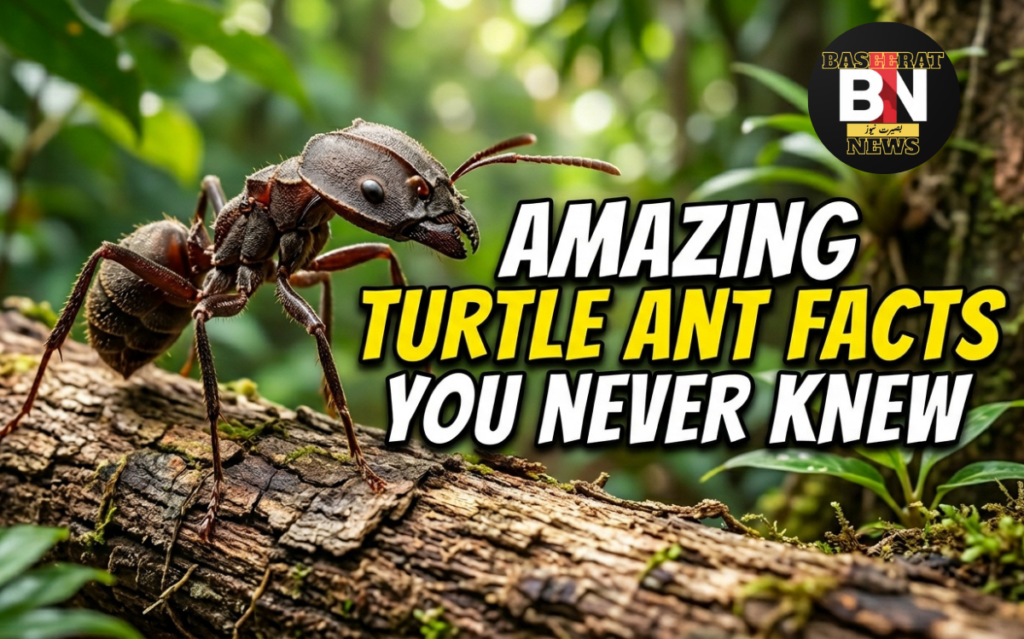
🐜 Turtle Ant (Cephalotes): The Incredible Gliding Ant of the Rainforest
🌿 A Falling Ant That Defies Gravity
Deep inside the world’s tropical rainforests, life unfolds high above the ground in a dense green architecture known as the canopy. Sunlight barely reaches the forest floor, and most of the ecosystem’s real activity happens dozens of meters above ground level.
In this elevated world lives one of nature’s most unusual insects—the turtle ant.
At first glance, it looks like a small, armored insect crawling carefully along branches. But its true marvel is revealed only when something unexpected happens: it falls.
Most insects would drop uncontrollably to the forest floor, where predators wait. But the turtle ant does something extraordinary. It does not simply fall—it steers. It adjusts its body mid-air, orients itself toward a tree trunk, and glides safely back to vegetation.
This ability has made scientists study it for years, especially species belonging to the genus Cephalotes ant, a group of highly specialized canopy-dwelling ants.
Unlike flying insects, turtle ants have no wings. Yet they perform controlled aerial movement with surprising precision. This rare adaptation, combined with their complex social systems and armored bodies, makes them one of the most fascinating insect groups in tropical ecosystems.
🐜 What Is a Turtle Ant?
The turtle ant is a specialized arboreal ant belonging to the genus Cephalotes. These ants are found primarily in tropical and subtropical forests, where they spend almost their entire lives in trees.
There are more than 100 known species of turtle ants distributed across Central and South America. They are part of the larger ant family Formicidae, but their evolutionary path is unique.
Unlike ground-dwelling ants that form trails on soil, turtle ants have adapted to life in the canopy. Their world consists of branches, twigs, leaves, and natural gaps between trees.
📊 Key Biological Facts
| Feature | Description |
|---|---|
| Scientific Group | Cephalotes |
| Common Name | Turtle Ant |
| Habitat | Tropical rainforest canopy |
| Distribution | Central & South America |
| Diet | Nectar, plant fluids, fungi |
| Movement Type | Walking + controlled gliding |
| Colony Structure | Queen, workers, soldiers |
| Lifespan | Several years (colony dependent) |
Their lifestyle is entirely three-dimensional. Instead of moving on flat ground, they navigate a complex aerial network of branches and gaps.
🐢 Why Are They Called Turtle Ants?
The name “turtle ant” comes from their physical appearance and defensive behavior.
Their bodies are unusually flat and heavily armored, resembling a miniature turtle shell. This shape helps them:
- Fit into narrow tree crevices
- Resist predators
- Survive falls and impacts
Even more interesting is the behavior of soldier ants within the colony. These ants have heads shaped like round, flat shields. They use them to block nest entrances, acting like living doors.
This defense mechanism is called phragmosis, where a body part evolves specifically to seal off an opening.
So the name “turtle ant” reflects both:
- Their armored appearance
- Their protective, defensive lifestyle
🌎 Habitat and Distribution: Life in the Canopy
Turtle ants are strictly associated with tropical ecosystems. They are widely distributed across:
- Central America
- South America
- Southern Mexico
- Caribbean forest regions
They are rarely found in cold climates or open grasslands.
🌳 Preferred Habitat Conditions
Turtle ants thrive in:
- Dense rainforest canopies
- Mangrove forests
- Tropical evergreen woodlands
They prefer environments with:
- High humidity
- Continuous tree connectivity
- Stable canopy pathways
Unlike many ants, they avoid the forest floor almost completely. The ground is dangerous, exposed, and filled with competing species and predators.
Instead, turtle ants build their entire ecological world above ground level, often inhabiting networks of trees that function like aerial highways.
🧬 Physical Characteristics: Built Like Living Armor
Turtle ants are small insects, but their bodies are highly specialized for survival.
📏 Size
Most species range from 5 mm to 15 mm in length.
🧱 Body Structure
Their bodies have three key adaptations:
- Flattened exoskeleton for tight spaces
- Strong, hook-like legs for gripping bark
- Hardened armor plates for protection
🎨 Color Variations
Depending on species:
- Dark black
- Brown
- Reddish-brown
- Mixed earthy tones
These colors help them blend into bark surfaces.
🛡 Soldier Ant Specialization
One of the most remarkable features is the soldier caste.
Soldiers have enlarged, disk-like heads that perfectly fit nest entrances. When danger approaches, they physically plug the opening using their heads.
This creates a living barricade that is extremely difficult for predators or invading ants to bypass.
🪂 The Science of Gliding: Nature’s Controlled Fall
Perhaps the most fascinating behavior of turtle ants is their ability to glide.
Unlike birds or flying insects, they have no wings. Yet when they fall, they rarely reach the ground.
Instead, they perform a controlled descent.
🧭 How Turtle Ant Gliding Works
When a turtle ant loses its grip:
- It immediately orients its head toward the nearest tree trunk
- It spreads its legs to increase air resistance
- It adjusts its body angle for stability
- It steers mid-air using subtle leg movements
- It lands back on a tree surface instead of falling to the ground
This behavior is not random. It is highly directional and goal-oriented.
🧠 Why Gliding Evolved
Scientists believe gliding evolved for survival efficiency:
- Prevents loss from falling to the forest floor
- Reduces predation risk
- Maintains colony connectivity
- Helps navigation in complex canopy environments
A fall in the rainforest canopy can be deadly. Gliding turns a dangerous accident into a controlled return.
🔬 Scientific Observations
Field research has shown that turtle ants:
- Rarely land randomly
- Prefer vertical surfaces (tree trunks)
- Can correct mid-air trajectory
- Maintain orientation even in chaotic falls
This makes them one of the most advanced non-flying aerial maneuvering insects known.
🏰 Colony Structure and Social Organization
Turtle ants live in highly organized colonies with a clear division of labor.
👑 Queen
The queen is responsible for reproduction and colony expansion. She remains inside protected nests.
🧹 Workers
Workers handle:
- Food collection
- Nest maintenance
- Trail construction
- Larvae care
🛡 Soldiers
Soldiers protect the colony and defend entrances using their specialized head structures.
🌐 Colony Network System
Unlike simple ant colonies, turtle ants often occupy multiple nest sites across several trees.
These nests are connected through canopy trails, forming a distributed network that can last for years.
This networked lifestyle increases resilience and reduces the risk of total colony collapse.
🍃 Diet and Feeding Behavior
Turtle ants are not aggressive hunters. Instead, they rely on plant-based resources.
Their diet includes:
- Nectar from flowers
- Plant sap
- Honeydew from insects
- Fungal material
- Bird droppings (occasionally)
Some species collect resources scattered across multiple trees, making them important participants in nutrient cycling within forest ecosystems.
🪵 Nesting Behavior: Life Inside Trees
Turtle ants build nests inside natural cavities such as:
- Hollow twigs
- Dead branches
- Small tree holes
- Bark cavities
🏠 Nest Features
- Multiple entrances
- Internal chambers
- Soldier-guarded doors
- Expandable structure across trees
Colonies often migrate or expand into new branches when resources allow.
Their nesting system is flexible, adaptive, and highly resilient.
📡 Communication and Navigation Systems
Turtle ants rely on multiple communication methods:
🧪 Chemical Communication
They release pheromones to:
- Mark trails
- Signal danger
- Coordinate movement
🖐 Physical Interaction
Antennal contact helps transfer:
- Information
- Direction cues
- Colony signals
🌐 Trail Network Intelligence
One of the most impressive traits is their ability to maintain trail networks in constantly changing environments.
Branches break, leaves fall, and paths shift—but turtle ants continuously repair and optimize their routes.
This behavior has inspired research in:
- Network optimization
- Computer algorithms
- Robotics pathfinding
🔬 Turtle Ants in Scientific Research
Turtle ants are studied across multiple disciplines.
🧠 Collective Intelligence
Their colonies behave like distributed computing systems, solving complex navigation problems without central control.
📊 Living Network Models
Researchers compare their trail systems to:
- Internet routing
- Traffic systems
- Communication networks
🦠 Microbiome Studies
Some studies explore microbial communities associated with turtle ants, including bacteria that influence colony health.
🐦 Predators and Environmental Threats
Despite their adaptations, turtle ants face several threats.
🐾 Natural Predators
- Birds
- Lizards
- Spiders
- Larger predatory insects
🌍 Environmental Risks
- Deforestation
- Habitat fragmentation
- Climate change
- Loss of canopy connectivity
Their survival depends heavily on intact rainforest ecosystems.
📌 Amazing Turtle Ant Facts
- They can glide without wings
- They live exclusively in trees
- Soldiers use heads as living doors
- Their bodies are armored like shields
- Colonies may last many years
- They rarely touch the ground
- They maintain complex trail systems
- Over 100 species exist
- They inspire computer science, models
- They are highly social insects
🌱 Ecological Importance
Turtle ants play a crucial role in rainforest ecosystems.
They help:
- Distribute nutrients
- Maintain plant-insect balance
- Support biodiversity
- Indicate forest health
Because they depend on continuous canopy systems, they are also indicators of environmental stability.
❓ Frequently Asked Questions (FAQs)
Can turtle ants fly?
No. They do not fly. They glide using body control.
Where do turtle ants live?
They live in tropical forests across Central and South America.
Why are they called turtle ants?
Because of their armored, turtle-like appearance and protective behavior.
What do turtle ants eat?
Nectar, plant sap, fungi, and organic materials.
Are turtle ants dangerous?
No, they are harmless to humans.
How do they glide?
They steer their bodies mid-air to return to the tree trunks.
🌿 Conclusion: A Small Insect With Extraordinary Abilities
Turtle ants are a powerful reminder that complexity in nature is not always tied to size.
Despite being only a few millimeters long, they:
- Build advanced societies
- Navigate complex canopy environments
- Control their descent through the air
- Defend colonies with specialized soldiers
- Maintain long-lasting ecological networks
Their combination of physical adaptation, behavioral intelligence, and environmental specialization makes them one of the most remarkable insects in tropical ecosystems.
In the vast green world of the rainforest canopy, the turtle ant proves that survival is not about strength alone. It is about adaptation, coordination, and precision.
Click the link below for more……
https://baseeratnews.com/honey-bees/
Click the link below for more……