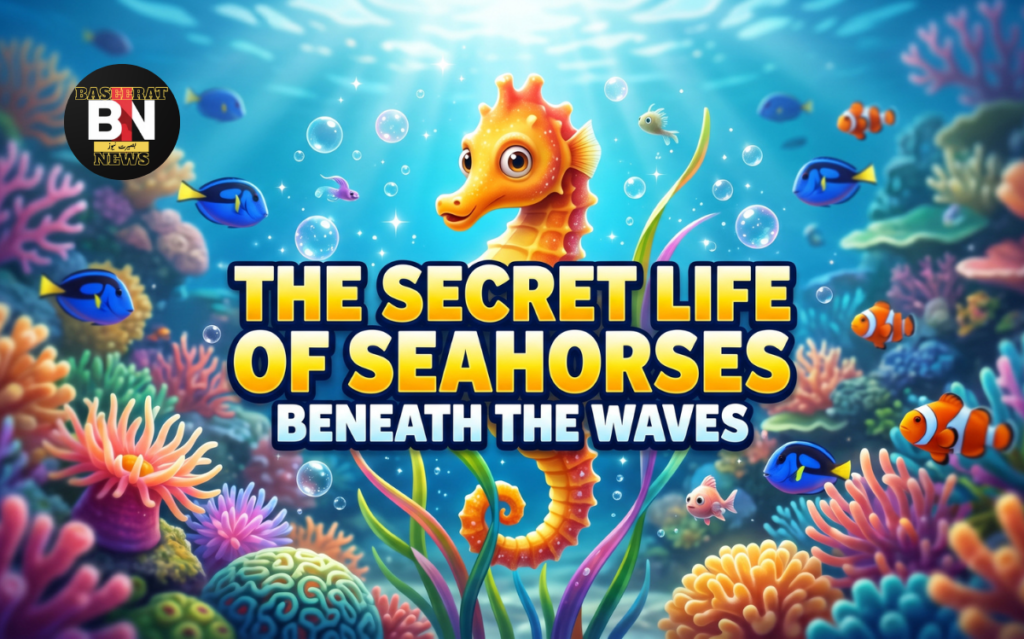
Seahorse: Amazing Facts About the Ocean’s Most Extraordinary Fish
Imagine floating through a quiet underwater meadow where strands of seagrass sway gently with the current. Hidden among those green blades is a creature so unusual that it looks as though it belongs in a fantasy story rather than the real world. It has the head of a horse, the tail of a monkey, the armor of a knight, and one of the most extraordinary parenting roles in the animal kingdom.
This remarkable creature is the seahorse.
Perhaps the most surprising fact about seahorses is that males—not females—become pregnant and give birth to their young. This rare biological phenomenon has fascinated scientists for centuries and continues to inspire new research today.
Seahorses are more than just curious-looking fish. They play important roles in marine ecosystems, serve as indicators of ocean health, and provide researchers with valuable insights into evolution, reproduction, and adaptation. Yet despite their popularity, many seahorse species face growing threats from habitat destruction, pollution, climate change, and illegal wildlife trade.
From tropical coral reefs to temperate seagrass beds, seahorses have adapted to some of the world’s most diverse marine environments. Their ability to camouflage, their unique body structure, and their unusual reproductive system make them among the most fascinating animals in the ocean.
In this comprehensive guide, you’ll discover how seahorses live, what they eat, where they are found, how they reproduce, and why scientists are paying closer attention to them than ever before. You’ll also learn about the latest research, conservation efforts, and surprising facts that make these tiny fish true wonders of the sea.
Quick Answer Box
What Is a Seahorse?
A seahorse is a small marine fish belonging to the genus Hippocampus. It is known for its horse-shaped head, upright posture, prehensile tail, and the unique ability of males to carry and give birth to offspring.
Quick Facts Table
| Fact | Details |
| Scientific Name | Hippocampus |
| Family | Syngnathidae |
| Number of Species | About 46 known species |
| Habitat | Seagrass beds, coral reefs, and mangroves |
| Size | 1.5 cm to 35 cm |
| Lifespan | 1–5 years (species dependent) |
| Diet | Small crustaceans and plankton |
| Distribution | Tropical and temperate oceans worldwide |
| Conservation Status | Many species are threatened |
| Unique Feature | Male pregnancy |
What Is a Seahorse?
Despite their unusual appearance, seahorses are true fish. They belong to the genus Hippocampus, a name derived from ancient Greek words meaning “horse” and “sea monster.”
Unlike most fish, seahorses swim upright. Their bodies are covered in bony plates instead of scales, giving them a natural suit of armor. Their flexible tails can grasp seagrass, coral branches, and other objects, helping them remain stable in ocean currents.
Scientists recognize approximately 46 species of seahorses. They vary dramatically in size, color, and habitat preferences. Some are small enough to fit on a fingernail, while others can reach lengths exceeding 30 centimeters.
Seahorses are considered flagship species for marine conservation because their survival depends heavily on healthy coastal ecosystems. When seahorse populations decline, it often signals broader environmental problems affecting other marine life.
History and Origins
The evolutionary history of seahorses stretches back millions of years. Fossil evidence suggests that the ancestors of modern seahorses evolved from pipefish-like species.
Scientists believe the development of seagrass habitats during ancient geological periods created ideal conditions for seahorse evolution. Their upright posture and grasping tails likely evolved as adaptations for life among underwater vegetation.
Ancient cultures were fascinated by seahorses. Greek mythology associated them with the sea god Poseidon, whose chariot was said to be pulled by horse-like sea creatures.
For centuries, sailors considered seahorses symbols of strength, protection, and good fortune. Dried seahorses have appeared in traditional medicines and cultural artifacts across various regions of the world.
Modern scientific research has transformed our understanding of seahorses, revealing complex behaviors and biological adaptations that few early observers could have imagined.
Physical Characteristics
Appearance
A seahorse’s appearance is unlike that of any other fish.
Its horse-like head, elongated snout, upright body, and curled tail create an instantly recognizable silhouette.
Size
Species range from tiny pygmy seahorses measuring less than 2 centimeters to large species exceeding 30 centimeters.
Color Variations
Seahorses can display a stunning range of colors, including:
- Yellow
- Orange
- Red
- Brown
- Black
- Purple
- White
Many species can change color to blend into their surroundings.
Special Adaptations
Their eyes move independently, allowing them to scan for predators and prey simultaneously.
Their tails function like an extra limb, enabling them to anchor themselves securely.
Their bony armor protects many predators.
Habitat and Distribution
Seahorses inhabit coastal waters throughout the world.
Common habitats include:
- Seagrass meadows
- Coral reefs
- Mangrove forests
- Estuaries
- Sheltered bays
Most species prefer shallow waters where vegetation provides camouflage and feeding opportunities.
The Indo-Pacific region contains the highest diversity of seahorse species, although they can also be found in the Atlantic Ocean and Mediterranean Sea.
Healthy seagrass ecosystems are particularly important because they provide shelter, breeding grounds, and abundant food.
Behavior and Lifestyle
Seahorses lead surprisingly complex lives.
Unlike many fish that form large schools, seahorses often live alone or in pairs.
Many species establish small home territories where they spend much of their lives.
Daily Activities
A typical day involves:
- Searching for food
- Avoiding predators
- Maintaining territory
- Interacting with mates
Communication
Seahorses communicate through body movements, color changes, and synchronized swimming displays.
Social Bonds
Some species form pair bonds that can last for extended periods.
Each morning, bonded pairs may perform greeting rituals involving synchronized movements and color changes.
Survival Strategies
Camouflage remains their primary defense. By blending into surrounding vegetation, they can become nearly invisible.
Diet and Feeding Habits
Seahorses are carnivores.
Their diet consists primarily of:
- Tiny shrimp
- Copepods
- Amphipods
- Larval fish
- Small crustaceans
Because they lack teeth and stomachs, food passes through their digestive systems rapidly.
As a result, seahorses must eat almost constantly.
Using their elongated snouts, they create a powerful suction force that pulls prey into their mouths in milliseconds.
A single seahorse may consume thousands of tiny prey items each day.
Reproduction and Life Cycle
Courtship
Seahorse courtship is among the most fascinating in the animal kingdom.
Pairs often engage in elaborate dances that can continue for several days.
Mating
The female transfers eggs into a specialized brood pouch located on the male’s abdomen.
Male Pregnancy
The male fertilizes the eggs internally and carries them in the pouch.
Inside, developing embryos receive oxygen, nutrients, and protection.
Birth
Depending on species and environmental conditions, pregnancy may last several weeks.
When ready, the male undergoes muscular contractions and releases dozens—or sometimes hundreds—of tiny seahorses.
Growth
Young seahorses receive no parental care after birth and must immediately fend for themselves.
Latest Research and Scientific Discoveries (2024–2026)
New Study: Male Pregnancy Insights
Recent genetic studies have provided a deeper understanding of how male seahorses support developing embryos.
Researchers discovered specialized immune adaptations that allow males to carry genetically distinct offspring without rejecting them.
This research may improve the understanding of reproductive biology across many species.
New Study: Climate Change Effects
Marine scientists have documented increasing stress on seahorse populations caused by rising ocean temperatures.
Changes in habitat quality and food availability may affect reproductive success and survival rates.
These findings highlight the importance of protecting coastal ecosystems.
New Study: Conservation Technology
Researchers are using environmental DNA (eDNA) techniques to detect seahorse populations without physically capturing animals.
This method allows conservationists to monitor populations more efficiently while minimizing disturbance.
The technology may revolutionize marine wildlife monitoring in the coming years.
What Experts Say
Marine biologists frequently describe seahorses as indicators of ecosystem health.
Healthy seahorse populations often reflect healthy seagrass beds, mangroves, and reef environments.
Conservation organizations emphasize that protecting seahorses helps protect countless other marine species sharing the same habitats.
Real-World Examples
Seagrass Restoration Success
Several coastal restoration projects have demonstrated that rebuilding seagrass habitats can lead to increased seahorse populations.
Marine Protected Areas
Protected marine zones in parts of Asia, Europe, and Australia have helped reduce habitat damage and improve survival rates.
Citizen Science Projects
Divers and underwater photographers increasingly contribute valuable sightings that assist researchers in tracking populations.
20 Fascinating Facts About Seahorses
- Male seahorses become pregnant.
- Seahorses are fish despite their unusual appearance.
- Their eyes move independently.
- They lack scales.
- They possess natural body armor.
- Some species are smaller than a fingernail.
- Others exceed 30 centimeters in length.
- They swim upright.
- Their tails can grasp objects.
- They are poor swimmers.
- They rely heavily on camouflage.
- They have no teeth.
- They have no stomach.
- They eat almost continuously.
- There are about 46 known species.
- Pygmy seahorses are masters of disguise.
- Seahorses inhabit tropical and temperate waters.
- Ancient Greeks associated them with Poseidon.
- They are indicators of ecosystem health.
- Many species face conservation challenges.
Importance to Humans and Nature
Ecological Value
Seahorses help maintain balanced marine food webs.
Scientific Importance
Their unique reproductive biology provides valuable research opportunities.
Educational Value
Seahorses inspire public interest in marine conservation.
Cultural Significance
They appear in myths, art, folklore, and traditional stories worldwide.
Threats and Challenges
Climate Change
Rising temperatures alter marine habitats.
Habitat Loss
Coastal development destroys critical seagrass and mangrove ecosystems.
Pollution
Plastic waste and chemical contamination threaten marine life.
Wildlife Trade
Millions of seahorses have historically been harvested for traditional medicine and souvenir markets.
Population Decline
Several species have experienced significant reductions in local populations.
Conservation Efforts
Protected Areas
Marine reserves provide safer habitats.
Habitat Restoration
Seagrass and mangrove restoration projects benefit seahorses.
International Regulations
Trade restrictions help reduce overexploitation.
Research Programs
Scientists continue monitoring populations and developing conservation strategies.
Common Myths About Seahorses
Myth #1
Seahorses are not fish.
Reality: They are true fish.
Myth #2
Only females care for offspring.
Reality: Male seahorses carry developing embryos.
Myth #3
Seahorses swim fast.
Reality: They are among the slowest swimming fish.
Myth #4
All seahorses look the same.
Reality: Species vary dramatically in size and appearance.
Myth #5
Seahorses only live in coral reefs.
Reality: Many inhabit seagrass beds and mangroves.
Seahorse vs Pipefish
| Feature | Seahorse | Pipefish |
| Body Shape | Upright | Horizontal |
| Tail | Prehensile | Usually non-prehensile |
| Swimming Style | Vertical | Horizontal |
| Appearance | Horse-like head | Elongated body |
| Habitat | Reefs, seagrass, mangroves | Similar coastal habitats |
Frequently Asked Questions
What is a seahorse?
A marine fish belonging to the genus Hippocampus.
Why do male seahorses get pregnant?
Male pregnancy increases reproductive efficiency and offspring survival.
How long do seahorses live?
Most species live between one and five years.
What do seahorses eat?
Primarily small crustaceans and plankton.
Are seahorses endangered?
Many species face conservation concerns due to habitat loss and exploitation.
Can seahorses change color?
Yes, many species can alter coloration for camouflage.
How many species exist?
Approximately 46 recognized species.
Where are seahorses found?
Throughout tropical and temperate oceans worldwide.
Are seahorses good swimmers?
No, they are relatively weak swimmers.
What is their biggest threat?
Habitat destruction is among the most serious threats.
Do seahorses have teeth?
No.
Do seahorses have scales?
No, they have bony plates.
How many babies can a male carry?
Depending on the species, dozens to hundreds.
Why are seahorses important?
They contribute to healthy marine ecosystems.
Can seahorses live in aquariums?
Some species can, but specialized care is required.
Key Takeaways
- Seahorses are unique marine fish.
- Males carry and give birth to offspring.
- They rely heavily on camouflage.
- Healthy habitats are essential for survival.
- Conservation efforts are increasingly important.
Conclusion
The seahorse is one of nature’s most extraordinary creations. Its horse-like head, grasping tail, armored body, and remarkable reproductive system make it unlike any other fish in the ocean.
Beyond their beauty and uniqueness, seahorses serve as important indicators of marine ecosystem health. Their survival depends on thriving seagrass beds, mangroves, and coral reefs—habitats that support countless other species as well.
As scientists continue uncovering new insights into seahorse biology and behavior, these tiny fish remind us how much remains to be discovered beneath the waves. Protecting them is not just about saving a single species. It is about preserving entire coastal ecosystems for future generations.
The next time you see a seahorse drifting gently through underwater vegetation, remember that you are looking at one of the ocean’s most remarkable evolutionary success stories.
Click the link below for more
https://baseeratnews.com/the-ultimate-sharks-ocean-predators/
Click the link below for more